3+2 CNC machining — also known as positional 5-axis machining — is one of the most cost-effective strategies available to processing plants today. As a technical decision-maker, choosing between 3+2 CNC machining and full 5-axis machining directly impacts your setup time, surface quality, and capital investment. At QiaoFeng CNC Machine, we have helped over 750+ processing plants across Europe, North America, and Southeast Asia navigate this exact decision since 2010. This guide compares both strategies with real-world data so you can invest wisely.
According to the 2024 Machining Centers Market Report by Mordor Intelligence, the global CNC machining center market is projected to grow at a CAGR of 6.8% through 2029, driven by demand for multi-axis capabilities in automotive, aerospace, and mold-making sectors. A separate analysis by Grand View Research (2023) confirms that 5-axis CNC adoption among small-to-mid-size manufacturers has accelerated, yet 3+2 positional machining remains the dominant choice for plants processing prismatic and angled-feature parts — accounting for an estimated 55–60% of multi-axis installations in job shops globally.
Founded in 2010 and based in Dalang Town, Dongguan, Guangdong, China, QiaoFeng has been manufacturing CE-certified CNC machines for over 15 years, serving 750+ customers worldwide. Every machine comes with a 2-year warranty and dedicated after-sales support.
1. What Is 3+2 CNC Machining? Key Concepts Explained
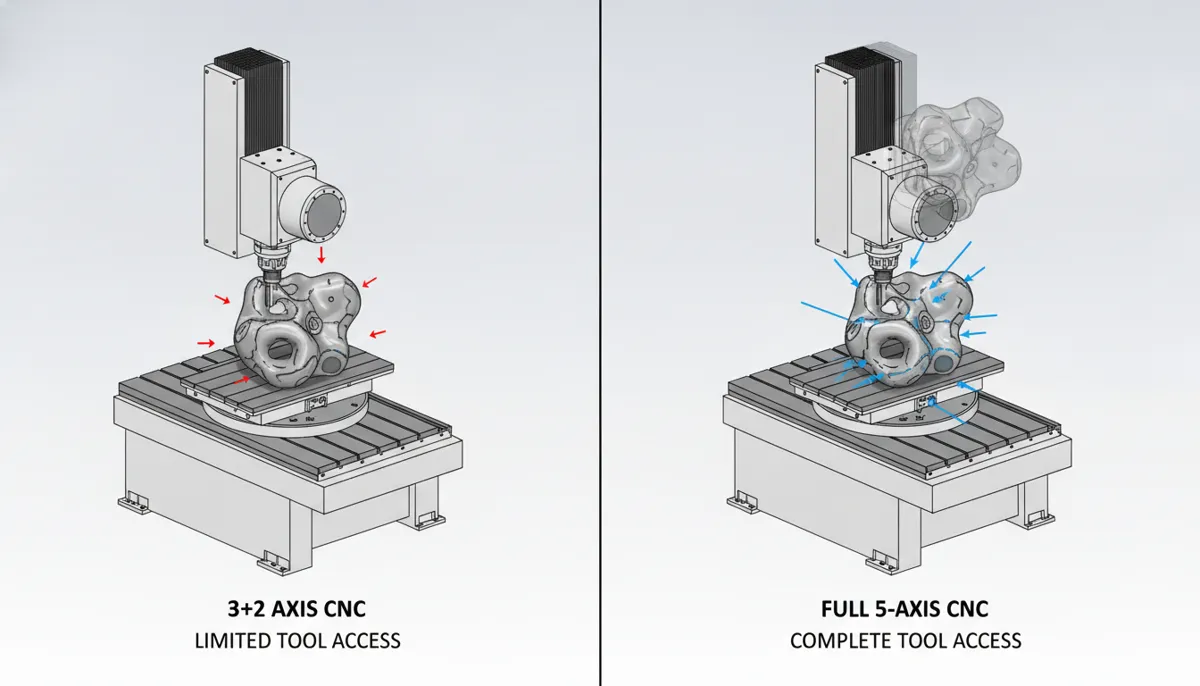
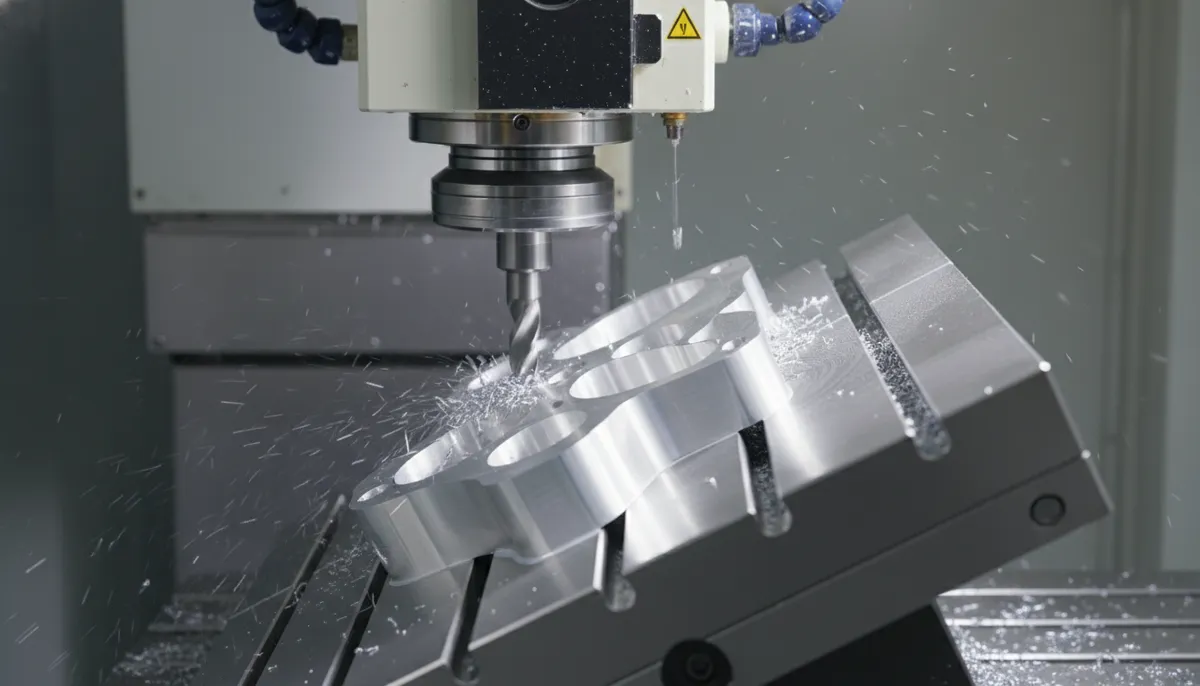
In 3+2 CNC machining, the workpiece is tilted and rotated to a fixed angle using two rotary axes (typically A and C), and then standard 3-axis cutting proceeds. This allows the machine to access multiple faces of a part in a single setup — without requiring continuous simultaneous 5-axis interpolation. The result is a significant reduction in re-clamping errors, setup time, and fixture costs compared to pure 3-axis machining.
Full 5-axis machining, by contrast, moves all five axes simultaneously and continuously. This enables the tool to follow complex freeform surfaces — such as turbine blades, medical implants, and aerospace impellers — with a single uninterrupted toolpath. The trade-off is higher machine cost, more complex CAM programming, and a steeper operator learning curve.
Understanding the difference between 5-axis and 3+2 positioning is the first step to making the right investment for your plant.
2. Detailed Comparison: 3+2 CNC Machining vs Full 5-Axis
| Parameter | 3+2 CNC Machining | Full 5-Axis CNC Machining |
|---|---|---|
| Axes of Motion | 3 linear (X, Y, Z) + 2 rotary positioned at fixed angles | Simultaneous 5-axis (X, Y, Z, A, C) continuous interpolation |
| Setup Time Reduction | 40–50% vs 3-axis; multiple setups eliminated | 60–70% vs 3-axis; single setup for complex parts |
| Surface Finish | Good (Ra 0.8–1.6 µm); may need hand finishing on complex contours | Excellent (Ra 0.4–0.8 µm); no hand finishing needed |
| Tool Access | Limited to fixed angles; undercuts and deep cavities challenging | Unrestricted; ideal for complex geometries and deep cavities |
| Typical Part Complexity | Moderate; prismatic parts with angled features | High; freeform surfaces, turbine blades, medical implants |
| Machine + Tooling Cost | $80,000 – $150,000 | $150,000 – $300,000+ |
| Programming Complexity | Moderate; similar to 3-axis CAM with rotary post-processor | High; advanced CAM simulation and collision checking required |
| Operator Skill Level | Medium; adaptable from 3-axis experience | High; specialized training required |
| Maintenance Cost | Lower; simpler mechanical design | Higher; complex kinematics require more upkeep |
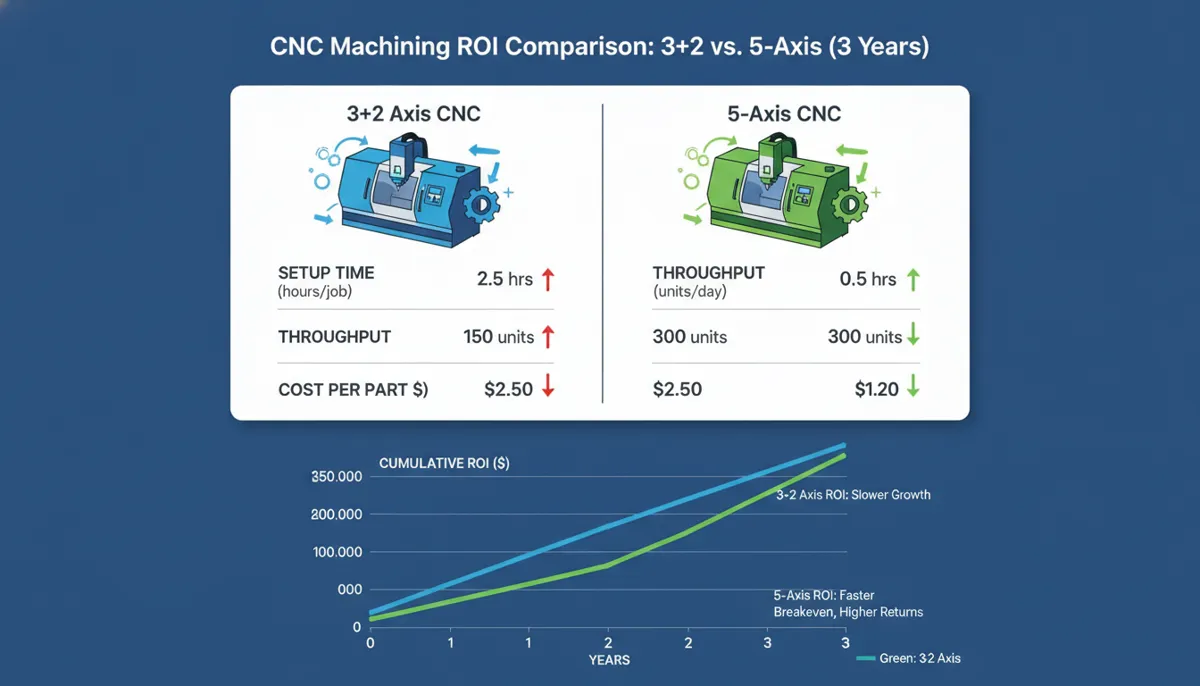
| Typical ROI Period | 12–18 months | 18–24 months |
The table above makes clear that 3+2 CNC machining delivers a strong ROI for plants processing parts with angled features, multi-sided geometries, and moderate complexity. Full 5-axis becomes the right choice when your part mix includes freeform surfaces, deep undercuts, or high-precision contours that fixed-angle positioning simply cannot reach. For most job shops and small processing plants, 3+2 CNC machining is the optimal first step into multi-axis production.
3. Core Features and Real-World Benefits of 3+2 CNC Machining
3.1 Positional 5-Axis Capability Without 5-Axis Cost
With 3+2 CNC machining, the workpiece is tilted to a fixed angle using a rotary/tilt table, and machining proceeds on a 3-axis basis. This eliminates re-clamping between operations, reducing cumulative positioning errors. For example, a processing plant producing valve bodies reduced setup time from 4 hours to 45 minutes per part — cutting lead time by 30% — without investing in a full 5-axis machine.
3.2 Cost-Effective Upgrade Path from 3-Axis
3+2 machines cost 40–60% less than full 5-axis machines while still enabling complex multi-sided geometries. A mid-size job shop reported a 15% increase in production capacity after switching from 3-axis to 3+2 CNC machining, with a payback period of just 18 months. For plants transitioning from 3-axis, this is the most financially defensible upgrade path.
3.3 Simplified Programming and Faster Operator Adoption
Unlike full 5-axis, 3+2 CNC machining programming is closely aligned with standard 3-axis CAM workflows. Operators with existing 3-axis experience can adapt quickly, reducing retraining costs. One plant reduced programming time by 20% compared to full 5-axis, enabling faster time-to-market for new product lines.
3.4 Shorter Tool Overhang = Better Surface Finish
By tilting the workpiece to an optimal angle, 3+2 CNC machining allows the use of shorter cutting tools with less overhang. This improves rigidity, reduces vibration, and delivers a better surface finish — often Ra 0.8 µm or better on aluminum — without the need for secondary polishing operations.
3.5 Dust, Coolant, and Chip Management
When planning your upgrade, factor in total operating costs. 3+2 machines typically use flood coolant for metal cutting, requiring a coolant management system ($2,000–$5,000). Full 5-axis machines often require through-spindle coolant for deep-cavity work, adding to both machine cost and maintenance complexity. Budget these into your ROI calculation from day one.
4. Customer Case Studies & Testimonials
Case Study 1: Valve Body Production — Germany
A hydraulic components manufacturer in Germany was running four separate 3-axis setups to machine valve bodies. After switching to 3+2 CNC machining with a QiaoFeng-recommended configuration, they consolidated to a single setup, reduced per-part cycle time from 4 hours to 52 minutes, and cut scrap rates from 6% to under 1.5%. ROI was achieved in 14 months.
“We had been running four separate 3-axis setups for our valve body line. After adopting 3+2 CNC machining, we cut cycle time by over 75% and our scrap rate dropped dramatically. The QiaoFeng team provided excellent technical support throughout the transition — they clearly understand what small processing plants actually need.”
Case Study 2: Aluminum Mold Inserts — United States
A mold shop in Ohio producing aluminum injection mold inserts needed to machine complex angled pockets that required three separate 3-axis setups. After adopting 3+2 CNC machining, they reduced setups to one, improved dimensional consistency across batches, and increased monthly output by 22%. The plant manager noted that the upgrade paid for itself faster than projected due to reduced fixture costs alone.
“We were skeptical that 3+2 CNC machining could replace our 3-axis multi-setup workflow for mold inserts. It absolutely did — and then some. Dimensional consistency improved noticeably, and we freed up a full machine for other work. QiaoFeng’s pre-sales consultation was detailed and honest. No overselling.”
Case Study 3: Custom Aluminum Brackets — Malaysia
An electronics enclosure manufacturer in Penang, Malaysia was outsourcing all angled-feature machining due to 3-axis limitations. After investing in a 3+2 CNC machining setup, they brought all production in-house, reduced per-unit cost by 35%, and shortened delivery lead times from 3 weeks to 5 days. The machine paid for itself within 16 months.
“Before 3+2 CNC machining, we were outsourcing all our angled bracket work and losing margin every time. Now we do everything in-house. Lead time went from three weeks to five days. QiaoFeng understood our budget constraints and helped us choose the right configuration — not the most expensive one.”
5. Pros and Cons of 3+2 CNC Machining
3+2 CNC Machining
✅ Pros
- 40–60% lower machine cost vs full 5-axis
- Eliminates multiple setups for multi-sided parts
- Shorter tool overhang = better surface finish & less vibration
- Easier CAM programming; adaptable from 3-axis experience
- ROI typically achieved in 12–18 months
- Lower maintenance cost and simpler kinematics
- Ideal for automotive, mold-making, and general machining
❌ Cons
- Cannot achieve continuous 5-axis contouring
- Limited access to deep undercuts at non-standard angles
- Not suitable for freeform surfaces (e.g., turbine blades)
- May still require secondary hand finishing on complex curves
Full 5-Axis CNC Machining
✅ Pros
- Continuous 5-axis interpolation for freeform surfaces
- Superior surface finish (Ra 0.4–0.8 µm) with no hand finishing
- Single setup for the most complex geometries
- Eliminates all re-clamping errors
- Essential for aerospace, medical, and high-precision sectors
❌ Cons
- $150,000–$300,000+ machine investment
- Complex CAM programming; requires specialized training
- Higher maintenance cost and longer downtime risk
- ROI period 18–24 months; harder to justify for simple parts
- Overkill for prismatic or moderately complex parts
6. When to Upgrade from 3+2 to Full 5-Axis CNC Machining
The decision to upgrade from 3+2 CNC machining to full 5-axis is rarely about capability alone — it is about whether your current part mix justifies the investment. Use the following triggers as a practical decision framework:
- Hand finishing exceeds 15% of production time — a clear signal that fixed-angle positioning is insufficient for your surface quality requirements.
- You are winning or targeting aerospace, medical, or high-precision contracts — sectors where freeform surfaces and tight tolerances are non-negotiable.
- Secondary operations account for more than one additional setup per part — full 5-axis eliminates these entirely.
- Your scrap rate on complex parts exceeds 3% — continuous 5-axis interpolation reduces positional errors that cause scrap.
- Monthly revenue from complex parts exceeds $50,000 — at this volume, the ROI math on a full 5-axis machine typically closes within 24 months.
QiaoFeng’s engineering team offers free ROI analysis for processing plants evaluating this upgrade. With 15 years of experience and 750+ installations across Europe, North America, and Southeast Asia, we can model your specific part mix and give you a realistic payback projection — not a sales pitch.
7. Frequently Asked Questions About 3+2 CNC Machining
What is the main difference between 5-axis and 3+2 CNC machining?
The key difference is motion type. 3+2 CNC machining positions the workpiece at a fixed angle using two rotary axes, then performs standard 3-axis cutting. Full 5-axis machining moves all five axes simultaneously, enabling continuous tool engagement with complex freeform surfaces. For prismatic parts with angled features, 3+2 is more cost-effective. For turbine blades, impellers, and medical implants, full 5-axis is essential.
When should I upgrade from 3+2 to full 5-axis CNC machining?
Consider upgrading when: (1) your parts require deep undercuts or complex curves that fixed-angle positioning cannot reach; (2) hand finishing or secondary operations exceed 15% of total production time; (3) you are targeting aerospace, medical, or high-precision contracts. For most job shops and small processing plants, 3+2 CNC machining remains the optimal choice for 3–5 years before a full 5-axis upgrade is justified.
Is 3+2 CNC machining obsolete now that 5-axis is more common?
Not at all. 3+2 CNC machining remains the dominant multi-axis strategy for automotive, mold-making, and general job shops globally. According to Grand View Research (2023), it accounts for an estimated 55–60% of multi-axis installations in small-to-mid-size manufacturing plants. Many facilities run a mixed fleet: 3+2 for standard production and full 5-axis for high-value complex components.
How does ROI compare between 3+2 and full 5-axis?
A typical 3+2 CNC machining setup achieves ROI in 12–18 months through reduced setup times, lower fixture costs, and increased throughput. Full 5-axis requires a higher initial investment ($150,000–$300,000+) but can pay off in 18–24 months if the part mix consistently includes complex geometries. Always include tooling, coolant systems, CAM software, operator training, and maintenance in your total cost of ownership calculation.
What is QiaoFeng’s warranty and return policy?
Every QiaoFeng CNC machine comes with a 2-year warranty covering mechanical and structural components. For quality-related issues confirmed by our technical team, we support returns and replacements. Please note that returns are not accepted for non-quality reasons (change of mind or application mismatch). Our after-sales team provides 24/7 remote support to resolve technical issues quickly and minimize downtime.
Does QiaoFeng offer both 3+2 and 5-axis CNC machines?
Yes. QiaoFeng supplies both 3+2 CNC machining configurations and full 5-axis machining centers, as well as standard 3-axis routers and mills. Our engineering team will assess your part mix, production volume, and budget to recommend the right solution — not the most expensive one. Contact us for a free consultation and ROI analysis.
Not Sure Whether 3+2 or Full 5-Axis Is Right for Your Plant?
Get a free, no-obligation ROI analysis from QiaoFeng’s engineering team. We’ll evaluate your part mix, production volume, and budget — and give you an honest recommendation based on 15 years of experience and 750+ plants served worldwide.
References
- Mordor Intelligence, Machining Centers Market Size, Share & Growth Trends Report, 2024.
- Grand View Research, CNC Machine Market Size, Share & Trends Analysis Report, 2023.
- Fortune Business Insights, CNC Machine Market Size, Share & COVID-19 Impact Analysis, 2023.
- Gardner Intelligence, World Machine Tool Survey, 2023.