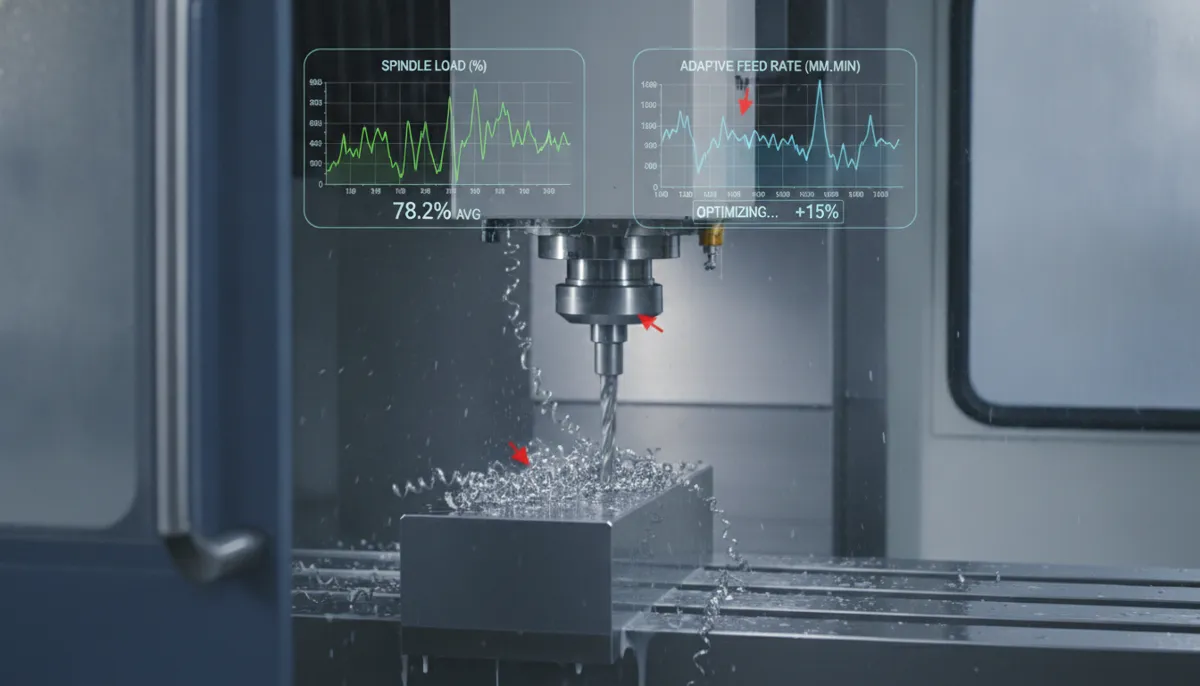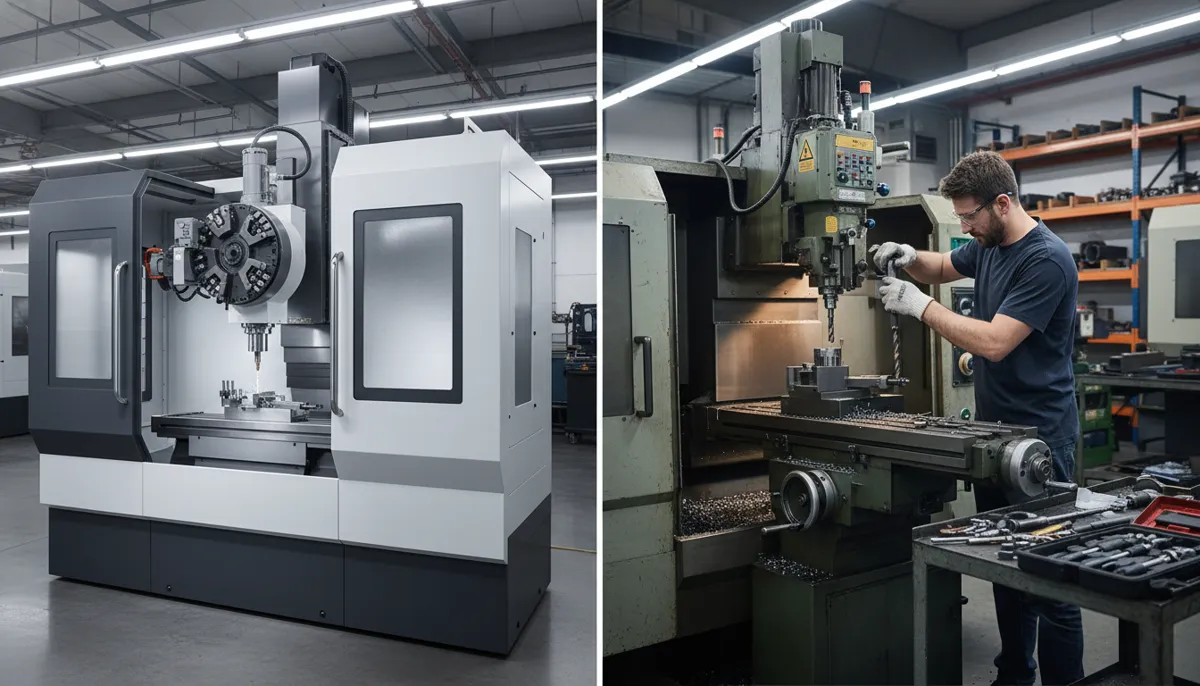
In the competitive world of precision machining, every second counts. Production supervisors constantly face pressure to increase output without sacrificing quality. A CNC automatic tool changer (ATC) is one of the highest-impact upgrades available — slashing non-cutting time, boosting spindle utilization, and enabling lights-out manufacturing. This guide covers everything you need to know about CNC automatic tool changer systems: how they work, real-world productivity data, a full ATC vs manual comparison, and how to calculate your ROI. At QiaoFeng — founded in 2010 in Daling Mountain Town, Dongguan, Guangdong — we’ve helped 750+ B2B clients across Europe, North America, and Southeast Asia maximize their CNC productivity over 15 years.
A CNC automatic tool changer stores multiple tools in a magazine and swaps them automatically during a machining cycle — eliminating the manual intervention that kills throughput. But not all ATC systems are equal. Understanding the key specifications, trade-offs, and ROI drivers is essential before investing. This guide gives you the data to make the right decision.
1. Why CNC Automatic Tool Changer Adoption Is Accelerating
The global CNC machining and turning centers market was valued at USD 25.99 billion in 2023 and is projected to grow at a CAGR of 6.6% through 2030, according to Grand View Research.[1] ATC-equipped machining centers represent the fastest-growing segment of this market, driven by manufacturers’ need to reduce labor dependency and increase spindle utilization.
The broader machine tools market — which encompasses ATC-equipped CNC machining centers — was valued at USD 112.03 billion in 2026 and is projected to reach USD 131.63 billion by 2031 (CAGR 3.28%), per Mordor Intelligence.[2] The primary growth driver is factory automation: manufacturers are replacing manual-change machines with ATC-equipped centers to reduce labor costs and enable 24/7 unattended production.
The dedicated automatic tool changers market was valued at USD 2.43 billion in 2025 and is projected to reach USD 4.96 billion by 2034 at a CAGR of 8.2%, per Dataintelo.[3] This near-doubling of market size over nine years reflects the manufacturing sector’s accelerating shift toward automated tool management as a core productivity strategy.
Meanwhile, Fortune Business Insights projects the global CNC machine market to grow from USD 108.58 billion in 2026 to USD 251.61 billion by 2034 (CAGR 11.10%) — with ATC integration cited as a key differentiator for premium machining centers.[4]
2. Real-World Pain Point: The Cost of Manual Tool Changes
To understand the ROI of a CNC automatic tool changer, consider a typical high-mix production scenario: a Tier 2 automotive supplier machining complex steel brackets. Their manual tool change process averaged 4 minutes per switch, with 20+ tool changes per job. This resulted in 80 minutes of non-cutting downtime per batch — time the spindle was stationary while an operator located, mounted, and offset each tool manually.
After installing a QiaoFeng CNC with ATC, changeover time dropped to 15 seconds per tool, cutting batch downtime to just 5 minutes. Productivity increased by 38%, and the investment was recovered in under 6 months — entirely from labor savings and increased throughput, without adding headcount or shifts.
This scenario is not exceptional. It is the standard outcome when plants replace manual tool change with a properly configured CNC automatic tool changer. The math is straightforward: every manual tool change that takes 3–5 minutes can be replaced by a 1.8-second automatic swap. On a job with 20 tool changes running three shifts, that’s over 4 hours of spindle time recovered per day.

3. Core Features of QiaoFeng’s CNC Automatic Tool Changer
3.1 CNC Automatic Tool Changer: 24-Tool Umbrella-Type Magazine
With a 24-tool capacity, the umbrella-style magazine stores a wide range of tools for diverse operations simultaneously. For a job requiring 18 different tools — drills, end mills, taps, boring bars — the ATC holds all tools loaded and ready, eliminating mid-cycle manual swaps entirely. This reduces setup time by up to 85% and eliminates the operator errors that occur during manual tool loading under production pressure.
3.2 1.8-Second Tool-to-Tool Change Time
QiaoFeng’s ATC achieves a 1.8-second chip-to-chip tool change — among the fastest in its class. In high-volume production of aluminum parts with 10 tool changes per part, this saves 18 seconds per part. Over a 10,000-part run, that’s 50 hours of spindle time recovered, directly increasing throughput by 20% with no additional labor or capital investment beyond the ATC itself.
3.3 Automatic Tool Length Measurement (ATC + Probe)
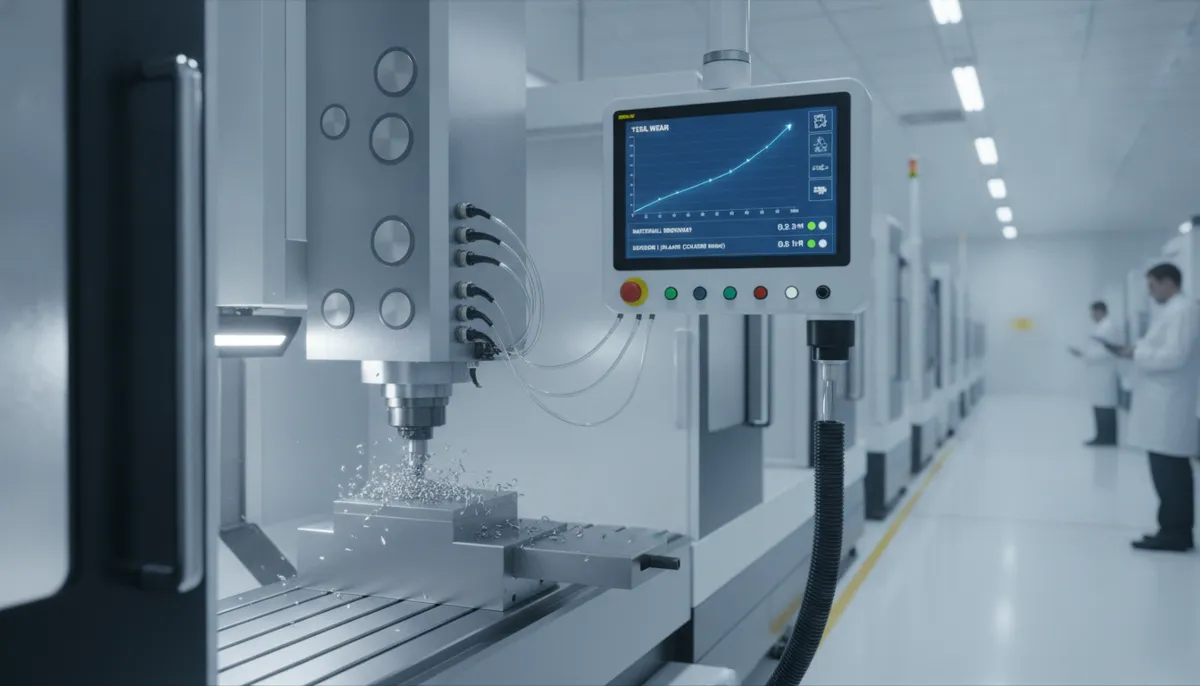
Integrated tool length measurement automatically compensates for tool wear and thermal growth in real time. Tool offsets are updated without operator intervention, eliminating the measurement errors that cause scrap. In production environments where this feature has been implemented, scrap rates have dropped from 3% to under 0.5% — a direct reduction in material waste and rework cost that compounds significantly at high volumes.
3.4 Dual-Arm Swing ATC Mechanism
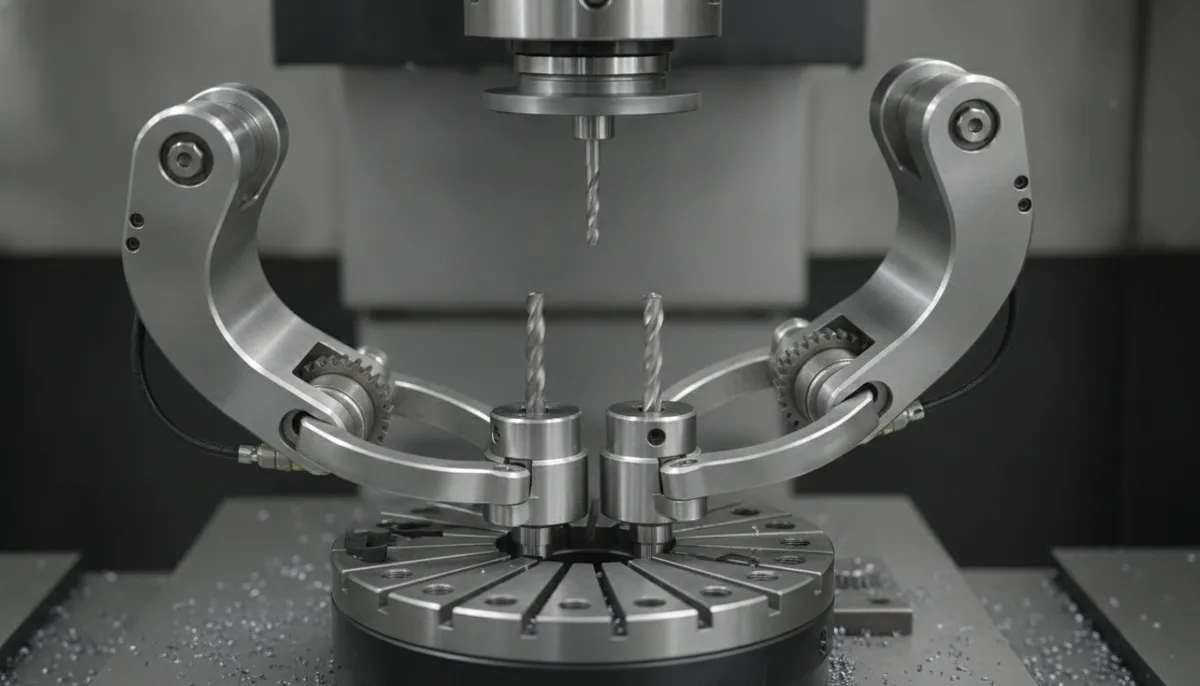
The dual-arm design retrieves the next tool from the magazine while the current tool is still cutting, then executes the swap in a single synchronized motion. Compared to single-arm ATCs, the dual-arm mechanism reduces change time by up to 30%, enabling faster cycle times for complex parts such as medical implants, aerospace brackets, and multi-feature mold components where tool changes are frequent.
4. CNC Automatic Tool Changer vs Manual Tool Change: Full Comparison
| Parameter | CNC with Automatic Tool Changer | Manual Tool Change |
|---|---|---|
| Tool Change Time | 1.8 sec (chip-to-chip) | 3–5 minutes per change |
| Spindle Utilization | 75–85% | 30–45% |
| Tool Capacity | 20–40+ tools (random access) | Limited by operator availability |
| Unattended / Lights-Out Operation | ✅ Fully supported | ❌ Not possible |
| Tool Change Repeatability | ±0.002 mm (consistent) | Variable — operator-dependent |
| Scrap Rate (typical) | 0.3–0.8% | 2–5% (offset errors) |
| Labor Requirement | Low — operator monitors, not changes | High — operator present every change |
| Throughput (20 changes/job) | ~36 sec total change time | ~80 min total change time |
| Setup Time (18-tool job) | Load once, run all | Manual swap each tool as needed |
| Initial Investment | 15–25% higher than manual | Lower upfront cost |
| Typical ROI Payback Period | 6–12 months | N/A (no productivity gain baseline) |
| Best For | High-mix, complex parts, 24/7 production | Simple, low-volume, single-operation jobs |
* Performance figures are based on typical production conditions. Results vary by material, tooling, part complexity, and machine configuration. Contact QiaoFeng for a personalized ROI analysis.
Want to Know Your Exact ROI from Switching to ATC?
Our engineers will calculate your specific payback period based on your current tool change frequency, batch sizes, and labor costs — at no charge.
5. When a CNC Automatic Tool Changer Delivers the Highest ROI
5.1 High-Mix, Low-Volume Production
Pain Point: Frequent changeovers for small batches of custom parts cause excessive non-cutting downtime. Each new job requires a different tool set, and manual loading consumes 20–40 minutes per setup.
Solution: A 24-tool ATC allows all required tools to be loaded once at the start of a shift. A job shop running 8–12 different part numbers per day reduced changeover time from 30 minutes to under 2 minutes per batch — increasing effective capacity by 40% without adding a single machine or operator.
5.2 Complex Parts Requiring Multiple Operations
Pain Point: Parts like engine blocks, hydraulic manifolds, and structural aerospace components require drilling, milling, tapping, and boring in a single setup. Manual tool changes between operations introduce offset errors and extend cycle time.
Solution: ATC automates the entire tool sequencing. An aerospace subcontractor machining titanium brackets achieved 99.8% first-pass yield after switching to ATC — eliminating the rework and scrap that had been caused by manual offset errors during multi-operation setups.
5.3 Lights-Out and Unattended Manufacturing
Pain Point: Unattended overnight runs are impossible with manual tool changes — production stops the moment the last operator leaves the floor.
Solution: ATC enables fully unattended 24/7 operation. A medical device manufacturer running stainless steel implant components now operates 16-hour unattended shifts, increasing total output by 70% with the same headcount. The ATC, combined with automatic tool length measurement, maintains dimensional accuracy throughout the unattended run without operator intervention.
6. What Production Supervisors Say About CNC Automatic Tool Changer
“We were running 22 tool changes per job on our steel bracket line — every one of them manual, every one of them costing us 4 minutes of spindle time. After installing QiaoFeng’s ATC system, that 88 minutes of dead time per batch collapsed to under 2 minutes. Our OEE went from 41% to 79% in the first quarter. The payback was faster than any capital investment I’ve approved in 12 years of running this plant.”
“We machine complex aluminum housings for industrial automation equipment — each part needs 14 different tools. Before ATC, we had an operator standing at the machine for every tool change. Now the machine runs the full cycle unattended and our operator manages two machines simultaneously. Throughput is up 55% and labor cost per part is down 40%. QiaoFeng’s 2-year warranty and fast spare parts support from Dongguan gave us confidence to commit to the investment.”
“Our shop in Penang machines medical device components and electronics enclosures — both require tight tolerances and frequent tool changes. We installed two QiaoFeng VMCs with 24-tool ATC and the difference was immediate. Scrap dropped from 4.5% to 0.6%, and we now run overnight unattended production five nights a week. The automatic tool length measurement feature alone paid for the machine upgrade within four months.”
7. Pros and Cons of CNC Automatic Tool Changer
✅ Pros of CNC with ATC
- Up to 90% reduction in tool change time
- Spindle utilization 75–85% vs 30–45% manual
- Enables fully unattended / lights-out production
- Consistent ±0.002 mm tool change repeatability
- Scrap rate reduced to 0.3–0.8%
- Handles 20–40+ tools in random-access magazine
- Reduces labor dependency per machine
- ROI typically recovered in 6–12 months
❌ Cons / Considerations
- 15–25% higher initial investment vs manual
- Requires periodic ATC alignment and lubrication
- ATC jam can cause downtime (mitigated by QiaoFeng’s 2-year warranty & remote diagnostics)
- Not cost-justified for very simple, single-tool jobs
- Retrofitting existing machines is often not cost-effective
8. Frequently Asked Questions About CNC Automatic Tool Changer
How does a CNC automatic tool changer compare to a turret-style tool changer?
ATC magazines hold significantly more tools — typically 20–40+ — and allow random tool selection in any order the program requires. Turret systems are limited to 8–12 tools and index sequentially, meaning the machine must cycle through intermediate positions to reach the target tool. For complex parts requiring many tools in non-sequential order, ATC is substantially faster and more flexible. Turrets are simpler and lower-cost but are best suited to turning operations with limited tool variety.
Can I retrofit a CNC automatic tool changer to my existing machine?
Retrofitting is technically possible on some machines but is rarely cost-effective. It requires significant mechanical modifications to the spindle head, magazine mounting, and control system — often costing 60–80% of a new ATC-equipped machine’s price. For most plants, investing in a new factory-integrated ATC machine delivers better reliability, full warranty coverage, and faster ROI. Contact QiaoFeng to discuss whether a retrofit or new machine is the right choice for your specific model.
What maintenance does a CNC automatic tool changer require?
Routine ATC maintenance includes: cleaning tool holders and taper sockets every shift, lubricating the arm mechanism and magazine drive weekly, and performing alignment checks every 500 operating hours. QiaoFeng provides a detailed preventive maintenance schedule with every machine and offers remote diagnostic support to identify issues before they cause downtime. A properly maintained ATC system achieves 99.5%+ uptime over its service life.
How much does a CNC with automatic tool changer cost compared to manual?
ATC-equipped CNC machining centers typically carry a 15–25% premium over equivalent manual-change machines. The exact figure depends on tool capacity, magazine type, and spindle specifications. However, the productivity gain of 30–50% in spindle utilization means the payback period is typically 6–12 months for any operation running 5+ tool changes per cycle. Contact QiaoFeng for current pricing and a personalized ROI calculation based on your production data.
What is QiaoFeng’s warranty and support policy on CNC machines with ATC?
All QiaoFeng CNC machines — including ATC-equipped models — come with a 2-year warranty covering all major components, including the ATC mechanism, spindle, and control system. Our team works closely with each client before purchase to ensure the right ATC configuration is matched to their specific production requirements — significantly reducing the risk of mismatched expectations. Warranty support is provided for all confirmed quality defects. For warranty claims, technical support, or spare parts, contact us at bella@qfcncmachine.com or call +86 151 1824 3737.
Ready to Eliminate Manual Tool Changes and Maximize Throughput?
QiaoFeng has equipped 750+ B2B machining operations with ATC solutions since 2010. Our engineers will help you select the right ATC configuration and calculate your exact payback period — at no cost.
References
- Grand View Research, CNC Machining and Turning Centers Market Size & Share Report, 2024–2030, 2024. View Report →
- Mordor Intelligence, Machine Tools Market Size, Share & Research Report, 2031, 2026. View Report →
- Dataintelo, Automatic Tool Changers Market Research Report, 2034, 2025. View Report →
- Fortune Business Insights, CNC Machine Market Size, Share & Industry Analysis, 2034, 2026. View Report →
- Mordor Intelligence, Machining Centers Market Size, Share & Growth Trends Report, 2024. View Report →