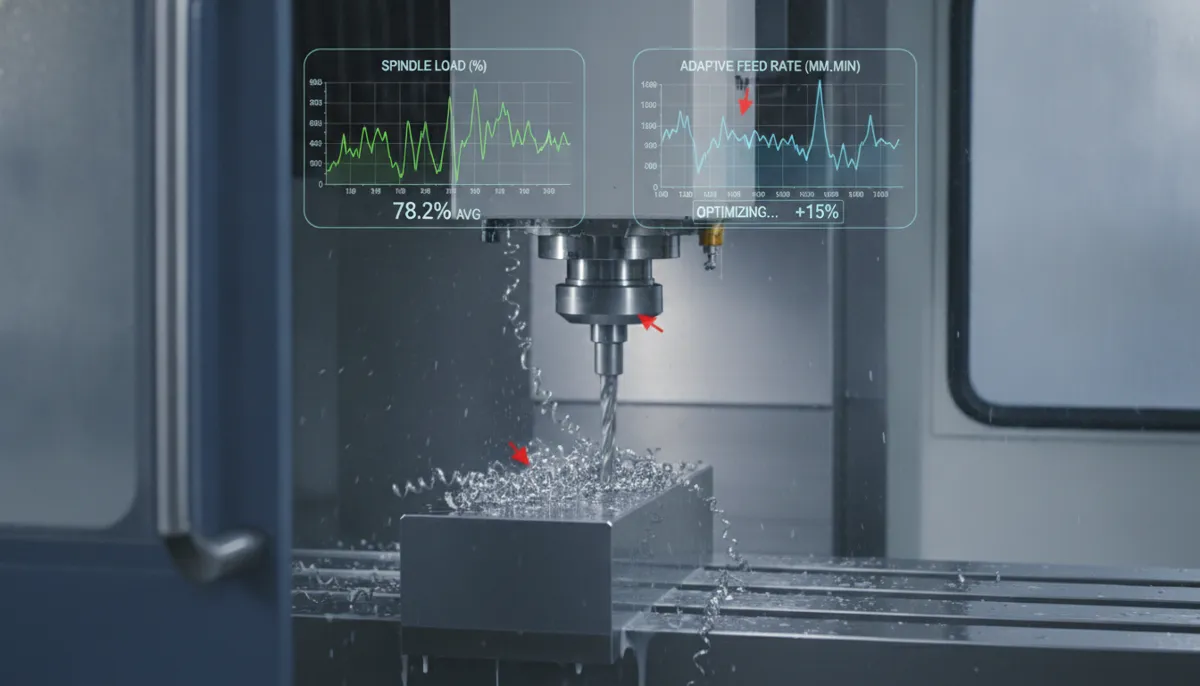
CNC federated learning is redefining how manufacturers harness AI across distributed factories — without ever surrendering sensitive production data. In the era of Industry 4.0, CNC shops face a paradox: the more machines they connect, the more valuable the collective intelligence becomes, yet sharing raw process data across sites raises serious privacy and IP concerns. CNC federated learning solves this by keeping raw data on-site while sharing only encrypted model updates — enabling cross-factory optimization that was previously impossible. QiaoFeng, founded in 2010 and headquartered in Dalingsham Town, Dongguan, Guangdong, has spent 15 years solving exactly this challenge. Our platform serves 750+ clients globally, helping manufacturers in aerospace, automotive, medical devices, and electronics achieve collective intelligence while maintaining full data sovereignty.
Why CNC Federated Learning Is Now a Competitive Necessity
The global AI in manufacturing market is accelerating rapidly. According to MarketsandMarkets (2024), the AI in manufacturing sector is projected to grow from USD 3.8 billion in 2023 to USD 20.8 billion by 2028, at a CAGR of 40.6% [1]. Yet adoption remains uneven: a McKinsey Global Institute report found that only 16% of manufacturers have successfully scaled AI beyond pilot projects, with data privacy and siloed infrastructure cited as the top two barriers [2]. Meanwhile, Deloitte’s 2024 Manufacturing Industry Outlook notes that manufacturers deploying collaborative AI frameworks reduce unplanned downtime by an average of 32% compared to those using isolated models [3].
These figures underscore a clear imperative: manufacturers who unlock cross-site intelligence while preserving data sovereignty will outpace competitors. CNC federated learning is the proven architecture to do exactly that — and QiaoFeng is the partner with the domain expertise to deploy it in real factory environments.
1. The Challenge: Data Silos Blocking Collective Optimization
Traditional centralized machine learning requires aggregating all data into one location. For CNC operations, this is often legally and commercially impossible: proprietary part geometries, cutting parameters, and quality metrics represent years of hard-won process knowledge. As a result, each plant independently develops predictive models on limited local data — yielding lower accuracy, higher scrap rates, and missed opportunities for cross-site benchmarking.
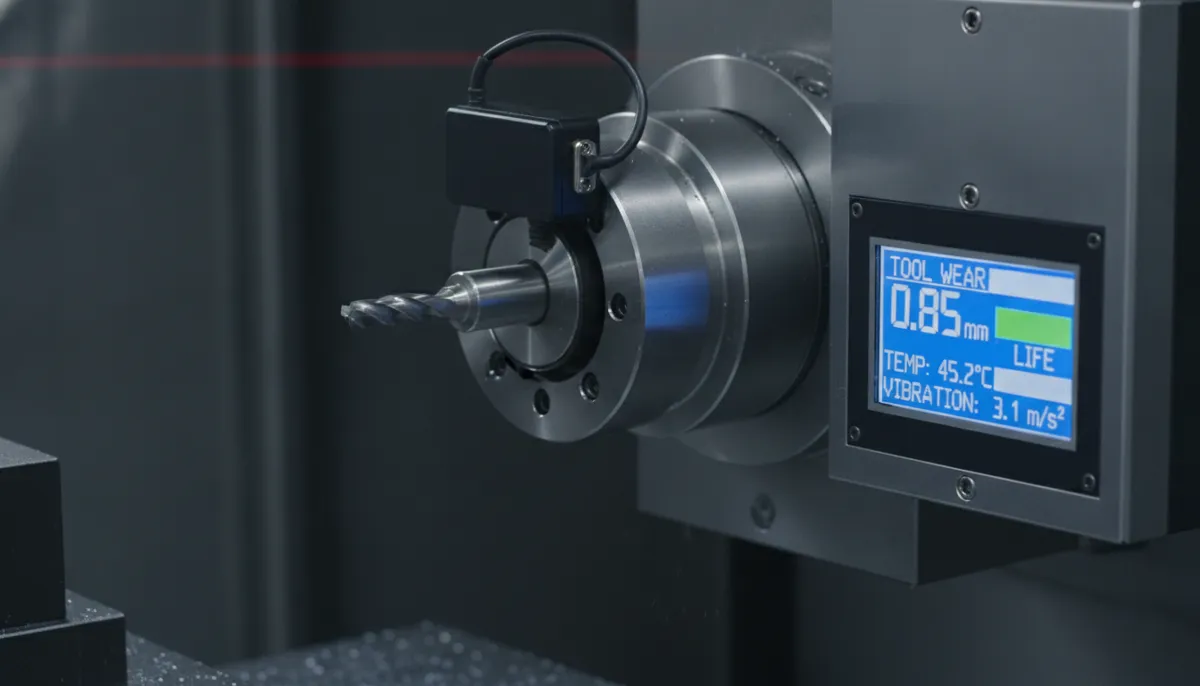
The consequences are measurable: isolated local models typically achieve 70–75% accuracy on tool wear prediction, while collaborative models trained via CNC federated learning routinely exceed 90%. The gap translates directly into unplanned downtime, excess tooling spend, and quality escapes.
2. How CNC Federated Learning Works: Step by Step
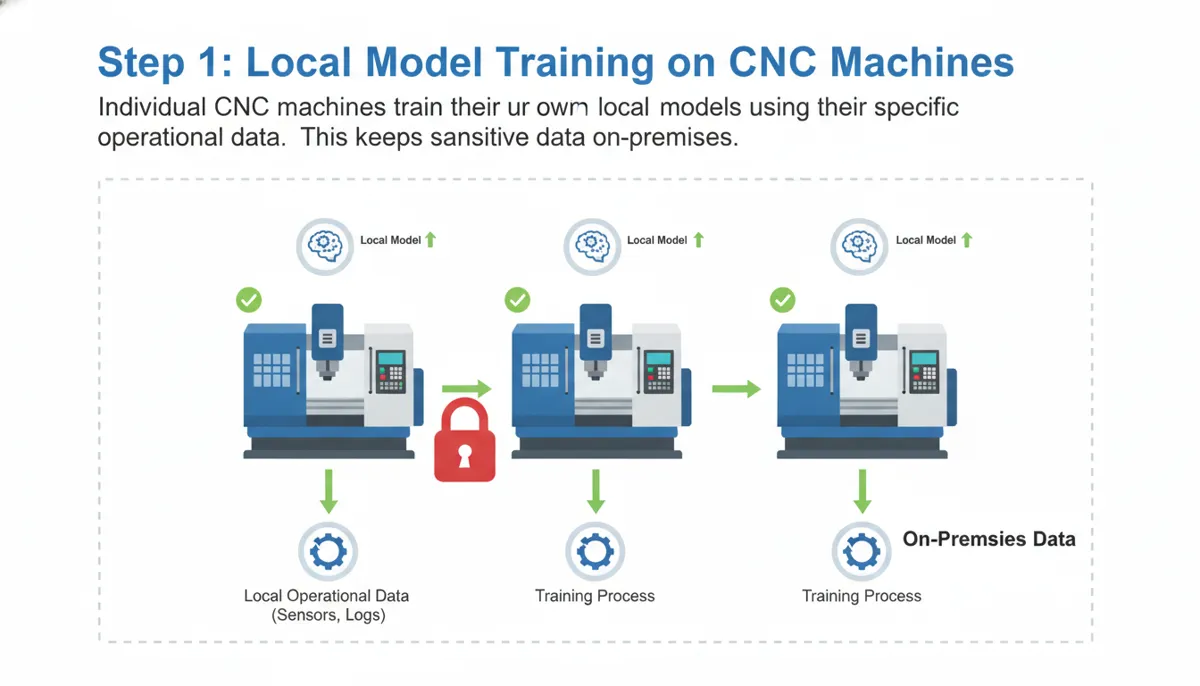
CNC federated learning inverts the traditional AI pipeline. Instead of sending data to a central server, the model travels to each factory. Here is the end-to-end flow:
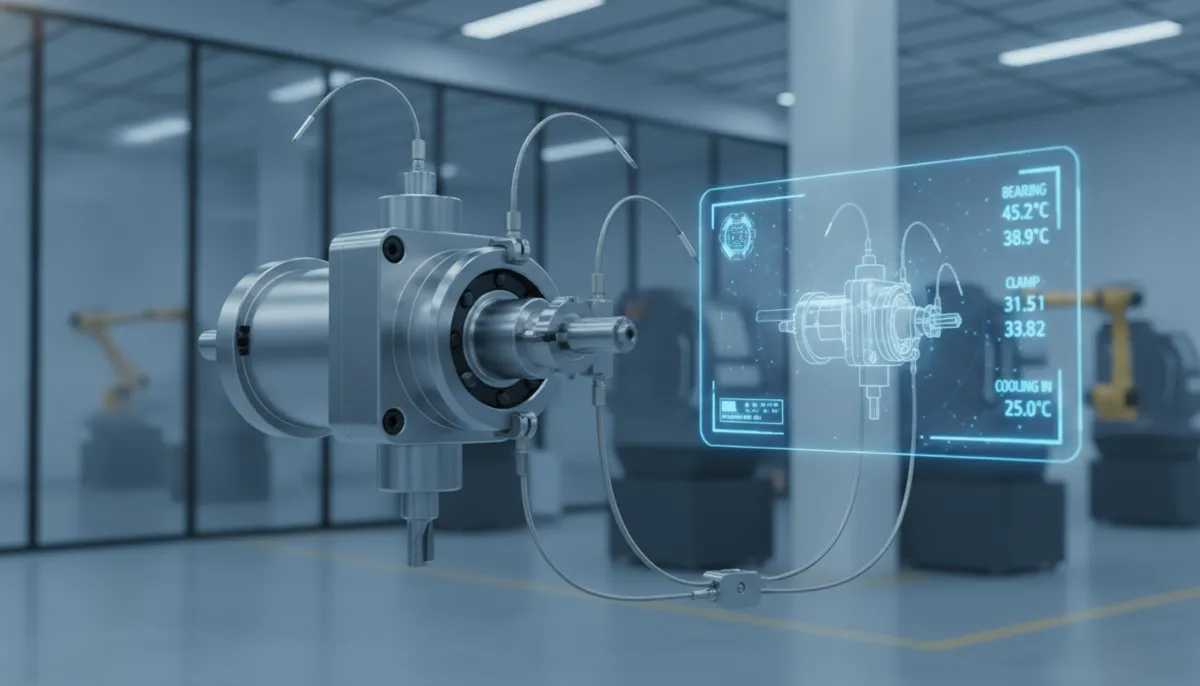
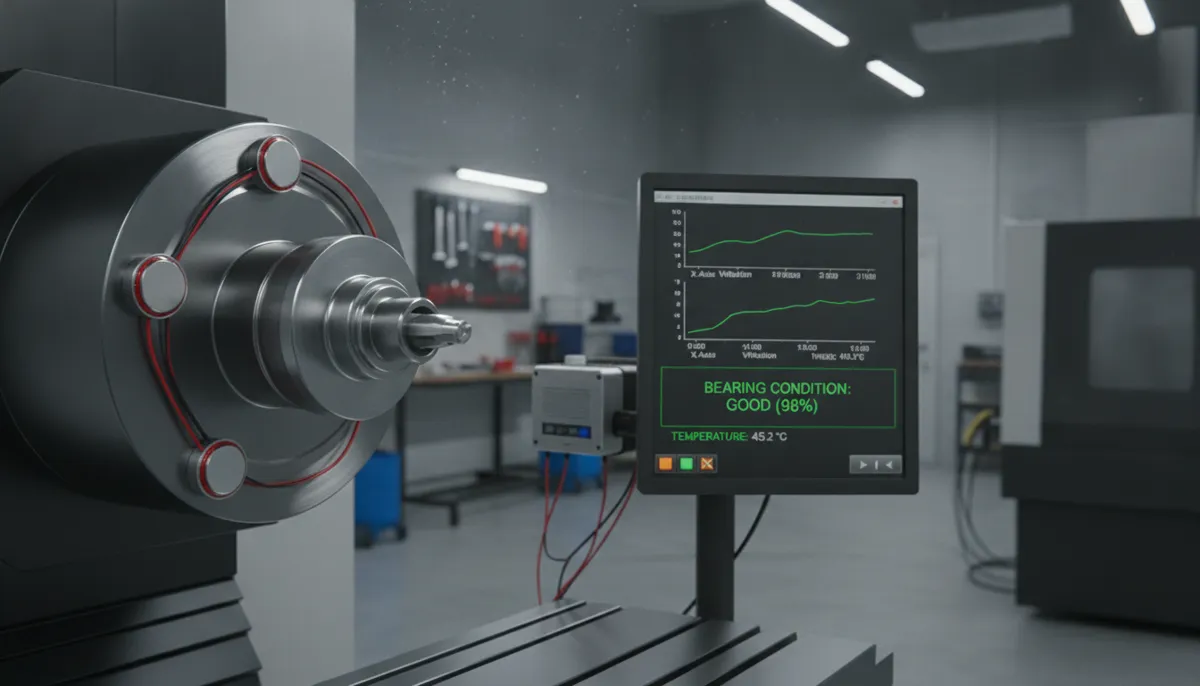
- Local Training: Each CNC machine or edge gateway trains a model on its own historical data — tool wear signals, vibration, temperature, CMM dimensional results.
- Encrypted Gradient Upload: Only model parameter updates — not raw data — are encrypted via TLS 1.3 and transmitted to the aggregation server.
- Secure Aggregation: The central server applies differential privacy and federated averaging (FedAvg) to combine updates into an improved global model.
- Global Model Redistribution: The enhanced model is pushed back to all participating sites for real-time inference.
Raw production data never leaves your facility. The result is a continuously improving global model that reflects the collective experience of your entire manufacturing network — the defining advantage of CNC federated learning over any single-site AI approach.
3. Core Features of QiaoFeng’s CNC Federated Learning Platform
3.1 Privacy-Preserving Architecture
Data never leaves the factory — only encrypted model parameters are shared. QiaoFeng’s CNC federated learning implementation incorporates differential privacy (calibrated noise injection) and secure multi-party computation, ensuring compliance with GDPR, CCPA, and China’s PIPL. Manufacturers can collaborate with partners or sister plants without legal hurdles or IP exposure.
3.2 Edge-Optimized for Legacy and Modern CNC
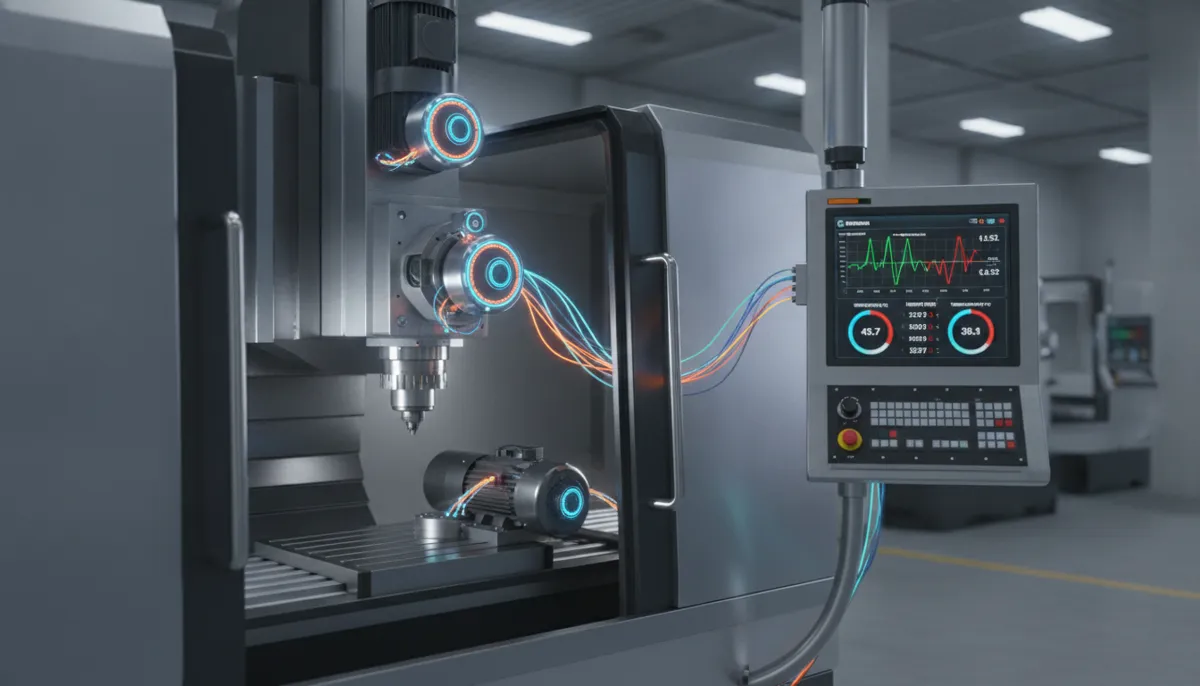
Lightweight model architectures (TensorFlow Lite, ONNX Runtime) run on existing edge devices — from industrial PCs to Raspberry Pi-class gateways. Training occurs during machine idle cycles, causing zero production disruption. For legacy CNC machines without native network connectivity, QiaoFeng supplies retrofit edge gateways connecting via serial port or PLC interface, transmitting only encrypted model updates over a secure VPN.
3.3 Scalable Heterogeneous Aggregation
Real-world CNC networks are messy: different machine brands (Fanuc, Siemens, Heidenhain), ages, and operating conditions produce non-IID data distributions. QiaoFeng’s proprietary aggregation algorithm handles this heterogeneity natively, weighting contributions by data quality and volume to prevent any single site from skewing the global model — a critical requirement for enterprise-scale CNC federated learning deployments.
3.4 Open Standards Integration
Built on TensorFlow Federated and PyTorch, the platform integrates with major MES, ERP, and SCADA systems via REST API. No vendor lock-in. Existing QiaoFeng CNC Cloud Edge customers can activate the CNC federated learning module as a software upgrade with no additional hardware required.
4. CNC Federated Learning vs. Centralized AI vs. No AI
| Dimension | No AI Baseline | Centralized AI | CNC Federated Learning |
|---|---|---|---|
| Data Privacy | N/A | ❌ Raw data leaves factory | ✅ Raw data stays on-site |
| Model Accuracy | ❌ Rule-based only | ✅ High (large dataset) | ✅ High (collective learning) |
| GDPR / CCPA Compliance | ✅ (no data sharing) | ⚠️ Requires legal agreements | ✅ By design |
| Cross-Site Collaboration | ❌ None | ⚠️ Requires data pooling | ✅ Native multi-site |
| Legacy Machine Support | ✅ Always | ⚠️ Retrofit needed | ✅ Retrofit gateway included |
| Unplanned Downtime Reduction | Baseline | ~25–30% | Up to 40% |
| Scrap Rate Reduction | Baseline | ~15–20% | Up to 25% |
| IP Risk | Low | ❌ High | ✅ Minimal |
| Deployment Complexity | Low | High | Medium (modular rollout) |
5. Real-World Use Case: Collaborative Tool Wear Prediction
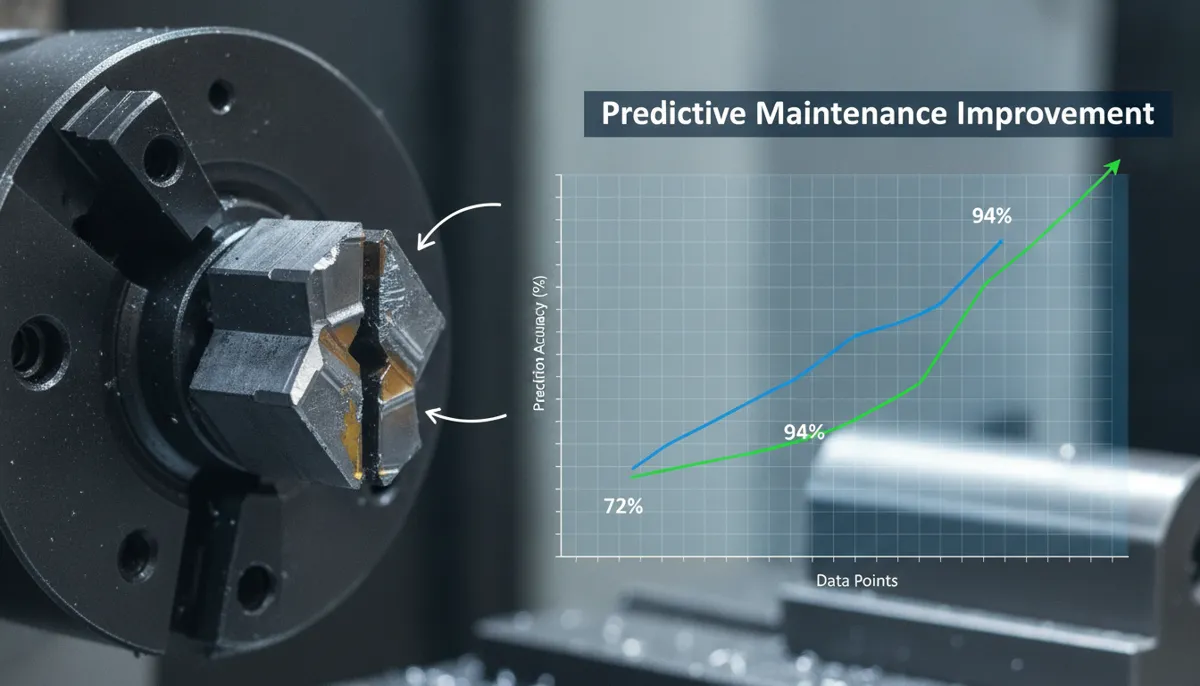
Pain Point: A global automotive manufacturer operated five CNC machining centers across the US, Germany, and Malaysia. Each site had its own tool wear dataset, but sharing raw vibration and acoustic emission data was prohibited due to IP agreements. Independent local models achieved only 72% average accuracy — insufficient for reliable predictive maintenance.
Solution: QiaoFeng deployed a CNC federated learning framework. Each plant trained a local model on its historical tool wear data. Only encrypted model gradients were transmitted to a central aggregation server. The improved global model was redistributed to all five sites for real-time inference — a textbook application of CNC federated learning in a multi-jurisdiction manufacturing environment.
Results (3 months post-deployment):
- Global model accuracy: 72% → 94%
- Unplanned downtime: reduced by 40%
- Annual tooling cost savings: USD 2.1 million
- Each plant retained 100% data sovereignty
What Our Clients Say About CNC Federated Learning
“We operate CNC lines in three countries and have always struggled to share process intelligence without exposing our IP. QiaoFeng’s CNC federated learning platform solved this completely. Within four months, our cross-site tool wear model hit 93% accuracy — something we never achieved with local models alone. The privacy architecture gave our legal team full confidence.”
“As a medical device manufacturer, data governance is non-negotiable. QiaoFeng’s CNC federated learning solution let us pool insights from our California and Minnesota facilities without any raw data crossing site boundaries. We reduced scrap on titanium implant components by 21% in the first quarter — and sailed through our FDA process validation audit.”
“We were skeptical that CNC federated learning could work on our older Fanuc machines, but QiaoFeng’s retrofit gateway made integration seamless. We now share model updates across our Penang and Johor Bahru plants, and our false-reject rate on precision housings dropped by 28%. The ROI was clear within six months.”
6. Pros & Cons of Adopting CNC Federated Learning
✅ Pros
- Raw data never leaves the factory — full IP and privacy protection
- Collective model accuracy surpasses any single-site model
- Native GDPR, CCPA, and PIPL compliance by architecture
- Compatible with legacy CNC machines via retrofit gateway
- Reduces unplanned downtime by up to 40%
- Open-standard stack (TensorFlow Federated, PyTorch) — no vendor lock-in
- 2-year warranty and 24/7 technical support included
❌ Cons
- Initial integration effort with existing MES/ERP systems
- Requires minimum ~1,000 data points per site for basic models
- Staff training needed on edge gateway management
- Not suited for millisecond real-time control loops (use edge inference instead)
- Multi-site coordination requires aligned data labeling conventions
Refund policy: QiaoFeng does not support no-reason returns for non-quality issues. Refunds are fully supported for verified quality defects. All deployments carry a 2-year warranty.
7. Frequently Asked Questions About CNC Federated Learning
Q1: What exactly is CNC federated learning, and how does it differ from standard machine learning?
Standard machine learning requires all training data to be centralized on one server. CNC federated learning keeps raw data on each local machine or edge device — only encrypted model gradient updates are shared. The central server aggregates these updates into a global model without ever seeing the underlying production data. This preserves IP, ensures regulatory compliance, and enables cross-site collaboration that would otherwise be legally or commercially impossible.
Q2: Is CNC federated learning secure against adversarial attacks?
Yes. QiaoFeng’s CNC federated learning solution incorporates differential privacy (calibrated noise injection per update), secure aggregation protocols (the server sees only the averaged result, never individual updates), and TLS 1.3 encryption for all communications. This combination defends against gradient inversion attacks, model poisoning, and inference attacks. Security parameters are configurable to meet your organization’s risk tolerance.
Q3: Can legacy CNC machines without network connectivity participate?
Absolutely. QiaoFeng supplies retrofit edge gateways that connect to serial ports, RS-232/485 interfaces, or PLCs on older Fanuc, Siemens, and Mitsubishi controllers. The gateway collects sensor data locally, performs on-device training, and transmits only encrypted model updates via a secure VPN — no direct internet access to the machine is required. This makes CNC federated learning accessible even to factories with decade-old equipment.
Q4: How much data is needed before CNC federated learning delivers value?
For classification tasks (e.g., tool wear state detection), as few as 1,000 labeled samples per site can yield a useful starting model. For more complex regression tasks (e.g., surface roughness prediction), we recommend at least 10,000 samples per site. Crucially, the federated architecture means that even sites with small datasets benefit from the collective knowledge of all participating nodes — a key advantage of CNC federated learning over isolated local models.
Q5: Can CNC federated learning be used for real-time machine control?
Federated learning governs model training (typically updated daily or weekly), not real-time inference. Once the global model is deployed to the edge device, inference runs locally at microsecond-to-millisecond speeds — fully compatible with real-time control loops. For closed-loop adaptive control, QiaoFeng recommends combining CNC federated learning (for model improvement) with our CNC Cloud Edge inference engine (for sub-millisecond actuation).
Q6: What is QiaoFeng’s warranty and refund policy?
All QiaoFeng CNC federated learning deployments carry a 2-year warranty covering hardware (edge gateways, sensors) and software platform updates. Refunds are supported for verified quality defects. We do not support no-reason returns for non-quality issues. For enterprise deployments, custom SLA agreements with guaranteed uptime are available — contact us to discuss your requirements.
Ready to Break Down Data Silos — Without Sacrificing Privacy?
Join 750+ manufacturers worldwide who trust QiaoFeng for intelligent CNC solutions. Request a free feasibility assessment and let our engineers design a pilot CNC federated learning deployment tailored to your factory network.
References
- MarketsandMarkets, AI in Manufacturing Market — Global Forecast to 2028, 2024. View Report
- McKinsey Global Institute, Capturing the True Value of Industry 4.0, 2023. View Report
- Deloitte, 2024 Manufacturing Industry Outlook, 2024. View Report
- Mordor Intelligence, Machining Centers Market Size, Share & Growth Trends Report, 2024. View Report
- Grand View Research, Industrial Internet of Things (IIoT) Market Size & Forecast Report, 2024. View Report