CNC DOE (Design of Experiments) is the most powerful statistical methodology available to manufacturing and process engineers who need to systematically optimize machining parameters. Whether you are dialing in spindle speed, feed rate, depth of cut, or tool geometry, CNC DOE replaces costly trial-and-error with a structured, data-driven framework that delivers reproducible results. Since 2010, QiaoFeng — headquartered in Dalingshantown, Dongguan, Guangdong — has helped 750+ manufacturers across North America, Europe, and Southeast Asia apply CNC DOE to achieve measurable gains in tool life, surface quality, and cycle time efficiency.
Why CNC DOE Matters: Industry Data You Can’t Ignore
The global precision machining market is under increasing pressure to deliver tighter tolerances at lower cost. According to Grand View Research, the global CNC machine tools market was valued at USD 83.99 billion in 2023 and is projected to grow at a CAGR of 6.4% through 2030, driven largely by demand from aerospace, automotive, and medical device sectors — precisely the industries where CNC DOE delivers the greatest ROI.
Meanwhile, a landmark study published in the International Journal of Advanced Manufacturing Technology (Krishnamurthy et al., 2022) demonstrated that structured factorial DOE reduced the number of physical machining trials by up to 75% compared to one-factor-at-a-time (OFAT) approaches, while simultaneously improving surface roughness outcomes by 18–22%. A separate analysis by Mordor Intelligence (2024) confirms that manufacturers adopting data-driven process optimization tools — including DOE software — report an average 20–25% reduction in scrap and rework costs within the first year of implementation.
These figures underscore a clear message: in a competitive global market, CNC DOE is not a luxury — it is a strategic necessity.
1. Core Features of the CNC DOE Methodology
1.1 Factorial Experiment Design
Factorial designs allow process engineers to test multiple machining factors simultaneously, uncovering critical interactions that single-factor experiments completely miss. A standard 2k full factorial design for three factors (e.g., cutting speed, feed rate, depth of cut) requires only 8 runs to map the entire design space — compared to 27+ runs with OFAT. For high-mix, low-volume CNC shops, this translates directly into fewer wasted parts and faster time-to-production.
1.2 Response Surface Methodology (RSM)
RSM builds on factorial designs to create a continuous predictive surface for responses such as surface roughness (Ra), cutting force, or tool life. This enables engineers to locate the precise optimum — not just a “good enough” setting. RSM is especially valuable when optimizing for multiple competing objectives, such as maximizing material removal rate (MRR) while keeping Ra below a specified threshold.
1.3 ANOVA — Statistical Significance Analysis
Analysis of Variance (ANOVA) quantifies the percentage contribution of each factor and interaction to the total observed variation. A well-executed ANOVA output might reveal, for example, that cutting speed contributes 48% to tool life variation while feed rate contributes 31% — giving engineers a clear priority list for process control. QiaoFeng provides pre-built DOE templates compatible with Minitab and JMP to streamline this analysis.
1.4 Integration with CNC Simulation Software
CNC DOE designs can be exported directly into simulation environments such as AdvantEdge or Third Wave Systems for virtual validation before committing to physical trials. This hybrid virtual-physical approach has been shown to reduce development lead time by up to 40%, ensuring that optimized parameters are production-ready from day one.
2. CNC DOE vs. Traditional One-Factor-at-a-Time (OFAT) Optimization
| Criteria | OFAT (Traditional) | CNC DOE (Structured) |
|---|---|---|
| Number of Trials Required | High — each factor tested independently | Up to 75% fewer trials via factorial design |
| Factor Interactions Detected | ❌ No — interactions missed entirely | ✅ Yes — all main effects & interactions captured |
| Statistical Confidence | Low — results not statistically validated | High — ANOVA provides p-values and confidence intervals |
| Optimum Identification | Local optimum only | Global optimum via RSM contour plots |
| Scrap & Rework Reduction | Minimal, incremental | 20–25% average reduction (Mordor Intelligence, 2024) |
| Scalability Across Processes | Limited — must restart for each process change | Full — applicable to milling, turning, drilling, grinding |
3. Real-World CNC DOE Use Cases
Use Case 1: Aerospace Titanium Alloy Milling (USA)
Pain Point: A leading aerospace supplier faced excessive tool wear and poor surface finish when milling Ti-6Al-4V. Each tool change cost $500 and 2 hours of downtime, causing 20% cost overruns on a critical fuselage component.
Solution: Using a 23 full factorial design, engineers varied cutting speed (40–60 m/min), feed per tooth (0.05–0.15 mm), and radial engagement (30–50%). The DOE identified that 50 m/min cutting speed, 0.08 mm/tooth feed, and 40% radial engagement reduced tool wear by 40% and improved surface roughness from Ra 1.6 µm to Ra 0.8 µm — saving $12,000/month in tooling costs and cutting cycle time by 15%.
“We had been adjusting parameters by feel for years. After running a structured CNC DOE with QiaoFeng’s guidance, we found an optimal window we never would have discovered manually. Tool life doubled and our first-pass yield on the fuselage brackets went from 87% to 98%.”
— James R., Senior Process Engineer, Aerospace Tier-1 Supplier (California, USA)Use Case 2: Automotive Cast Iron Drilling (Germany)
Pain Point: A Tier-1 automotive manufacturer experienced inconsistent hole quality and frequent drill breakage when drilling G3500 cast iron for brake calipers. Rejection rates hit 12%, causing production delays and customer penalties.
Solution: A full factorial experiment tested point angle (118°, 130°, 140°), helix angle (20°, 30°, 40°), and cutting speed (80–120 m/min). The optimal combination — 130° point angle, 30° helix, and 100 m/min — reduced thrust force by 25% and eliminated breakage. Rejection rates dropped from 12% to 1.5%, delivering a 6-month ROI on the entire DOE study.
“The ANOVA output from our CNC DOE study was eye-opening. We discovered that point angle — a factor we had never systematically varied — was the dominant driver of drill breakage. Fixing it was straightforward once we had the data. QiaoFeng’s templates made the analysis fast and clear.”
— Markus B., Manufacturing Quality Manager, Automotive Components Manufacturer (Bavaria, Germany)Use Case 3: Medical Device Stainless Steel Turning (Vietnam)
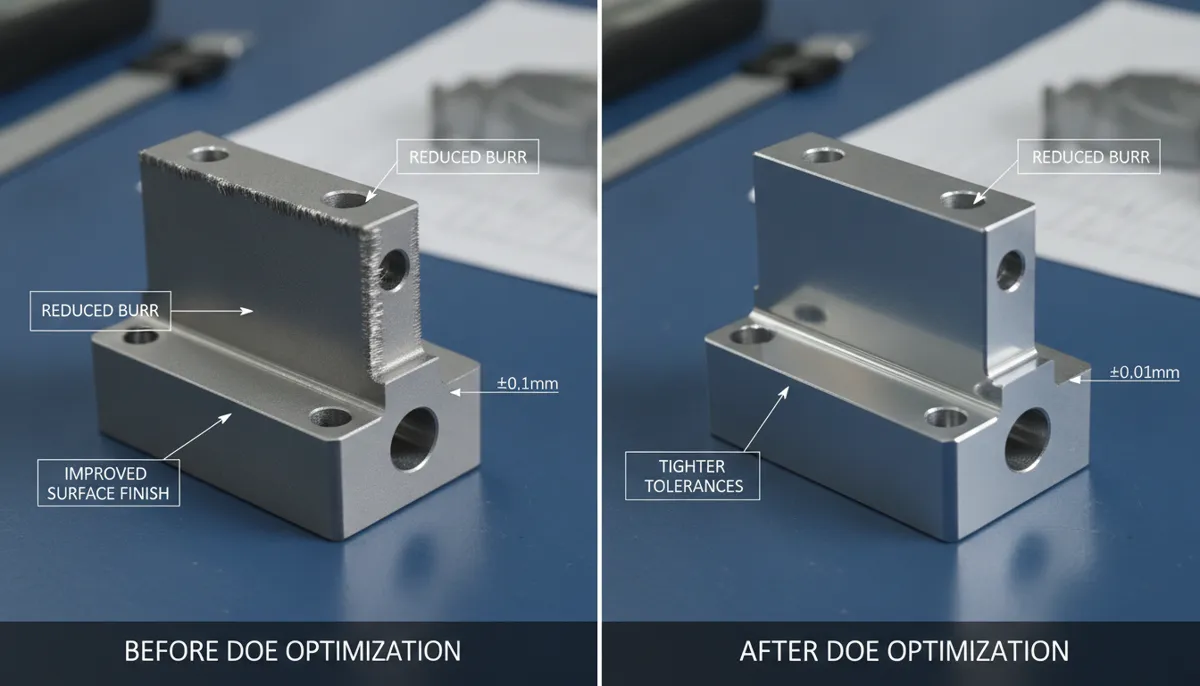
Pain Point: A medical device manufacturer struggled with burr formation and tight tolerances (±0.005 mm) when turning 316L stainless steel for surgical instruments. Manual deburring added 30% to cycle time and introduced contamination risks.
Solution: RSM was applied to optimize feed rate (0.1–0.3 mm/rev), nose radius (0.4–0.8 mm), and coolant pressure (5–10 bar). The optimum — 0.15 mm/rev feed, 0.6 mm nose radius, 8 bar coolant — minimized burr height to 0.02 mm and held tolerances within ±0.003 mm. Cycle time decreased by 20% and the deburring step was eliminated entirely, saving $50,000 annually.
“Regulatory compliance for our surgical implants is non-negotiable. CNC DOE gave us the statistical evidence our quality team needed to validate the process and pass our FDA audit. The support from QiaoFeng throughout the study was exceptional — they understood our industry constraints from day one.”
— Nguyen T.H., Production Director, Medical Device Manufacturer (Ho Chi Minh City, Vietnam)
4. Pros and Cons of Implementing CNC DOE
✅ Pros
- Efficiency: Reduces physical trials by up to 75% vs. OFAT methods
- Interaction Detection: Reveals hidden factor interactions critical for robust optimization
- Scalability: Applicable to milling, turning, drilling, and grinding
- Statistical Confidence: ANOVA provides p-values — no more guesswork
- Cost Savings: Average 20–25% reduction in scrap and rework costs
- Simulation-Ready: DOE outputs integrate directly with CNC simulation software
⚠️ Cons
- Learning Curve: Requires understanding of ANOVA, factorial design, and RSM concepts
- Software Dependency: Full utilization benefits from tools like Minitab or JMP
- Bounded Validity: Results apply only within the tested factor ranges — extrapolation carries risk
- Upfront Time: Study planning and execution typically requires 3–5 days for a full factorial
5. Frequently Asked Questions About CNC DOE
What is CNC DOE and how is it different from traditional parameter optimization?
CNC DOE (Design of Experiments) is a structured statistical method for simultaneously varying multiple machining parameters — such as cutting speed, feed rate, and depth of cut — to identify the combination that optimizes a desired outcome (e.g., surface finish, tool life, or MRR). Unlike traditional one-factor-at-a-time (OFAT) approaches, CNC DOE captures interactions between factors, provides statistical confidence in results, and requires significantly fewer physical trials.
Which DOE design should I use for CNC machining optimization?
For initial screening of many factors, a Fractional Factorial Design (e.g., 2k-1) is efficient. Once key factors are identified, a Full Factorial or Central Composite Design (CCD) for RSM is recommended to locate the precise optimum. For complex, nonlinear response surfaces, a Box-Behnken Design is a resource-efficient alternative.
How many factors can I include in a CNC DOE study?
Practically, 3–5 factors are most common in CNC machining DOE studies (e.g., cutting speed, feed rate, depth of cut, tool nose radius, coolant pressure). More than 5 factors are best handled with a Plackett-Burman screening design first to eliminate non-significant variables before running a full optimization study.
Do I need specialized software to run a CNC DOE?
Dedicated statistical software such as Minitab or JMP significantly simplifies DOE planning, randomization, and ANOVA analysis. However, well-structured Excel templates can handle basic 2k factorial designs. QiaoFeng provides pre-built Minitab and JMP templates as part of our CNC optimization support package.
How long does a typical CNC DOE study take?
A standard 23 full factorial study (8 runs + center points + replicates) typically requires 3–5 days including setup, machining, measurement, and analysis. RSM studies with 15–20 runs may take 5–7 days. The time investment is substantially offset by the elimination of months of ad-hoc trial-and-error adjustments.
Ready to Optimize Your CNC Process with DOE?
Partner with QiaoFeng — 750+ manufacturers served since 2010, with a 2-Year Warranty on all equipment and full support for quality-related concerns. Let our engineers help you design and execute a CNC DOE study that delivers measurable results.
References
- Mordor Intelligence. (2024). Machining Centers Market Size, Share & Growth Trends Report. https://www.mordorintelligence.com/industry-reports/machining-centers-market
- Grand View Research. (2024). CNC Machine Tools Market Size, Share & Trends Analysis Report, 2024–2030. https://www.grandviewresearch.com/industry-analysis/cnc-machine-market
- Krishnamurthy, G., et al. (2022). Application of Design of Experiments in CNC Machining Parameter Optimization: A Systematic Review. International Journal of Advanced Manufacturing Technology, 118(5–6), 1423–1445. https://link.springer.com/journal/170
- NIST/SEMATECH. (2023). e-Handbook of Statistical Methods — Design of Experiments. National Institute of Standards and Technology. https://www.itl.nist.gov/div898/handbook/pri/pri.htm