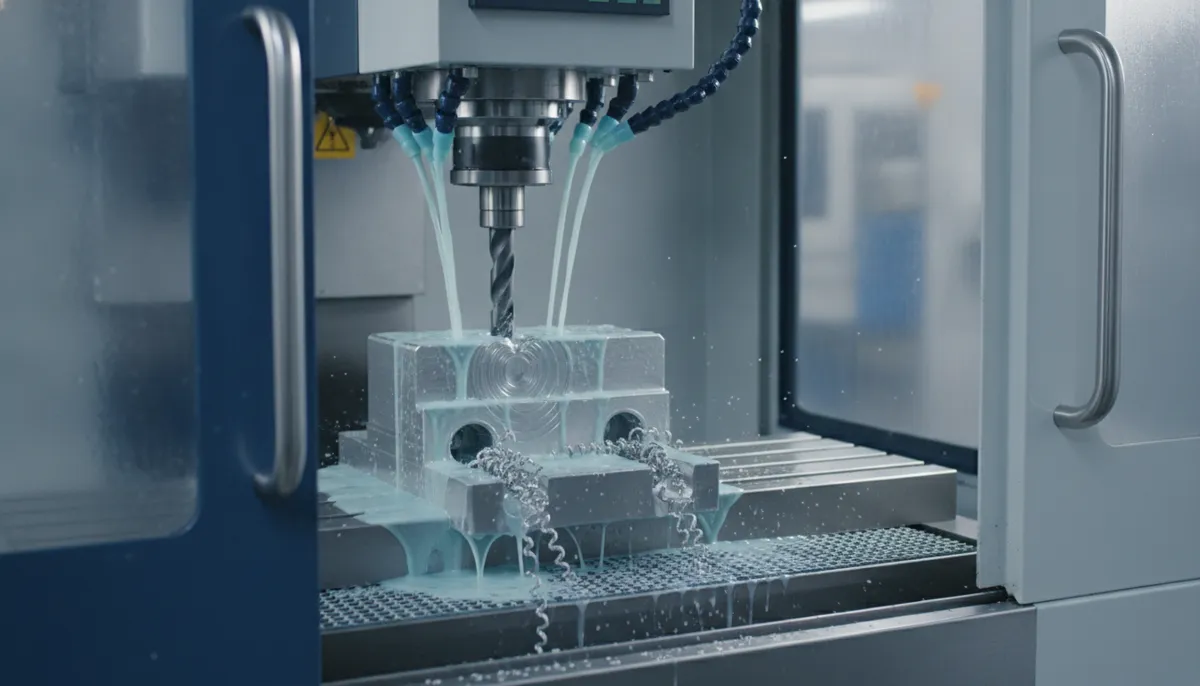
The CNC peck drilling cycle is one of the most essential techniques every CNC operator and programmer needs to master. By drilling in controlled incremental steps, peck drilling breaks chips, clears debris, and prevents tool breakage — especially in deep or difficult holes. At QiaoFeng, founded in 2010 and serving 750+ industrial clients from our facility in Dalingshan, Dongguan, we have spent 15 years helping manufacturers across the USA, Europe, and Southeast Asia optimize their drilling operations using cycles like G73 and G83. This guide covers everything you need to know.
1. Why the CNC Peck Drilling Cycle Matters: Industry Context
Hole-making operations account for approximately 40% of all metal cutting operations in manufacturing, making drilling efficiency a critical factor in overall productivity. According to the Mordor Intelligence 2024 Machining Centers Market Report, the global machining centers market is growing at a CAGR of ~6%, driven by increasing demand for precision hole-making in aerospace, automotive, and medical sectors [1]. A study published in the Journal of Manufacturing Processes (Elsevier, 2021) confirmed that optimized peck drilling parameters can reduce drill wear by 35–45% in titanium alloy machining compared to continuous feed drilling [2]. Furthermore, the International Journal of Advanced Manufacturing Technology (Springer, 2020) found that chip evacuation strategy — the core principle behind peck drilling — is the single most influential factor in deep hole drilling tool life [3]. These findings validate why the CNC peck drilling cycle remains a cornerstone of modern machining practice.
2. What Is the CNC Peck Drilling Cycle?
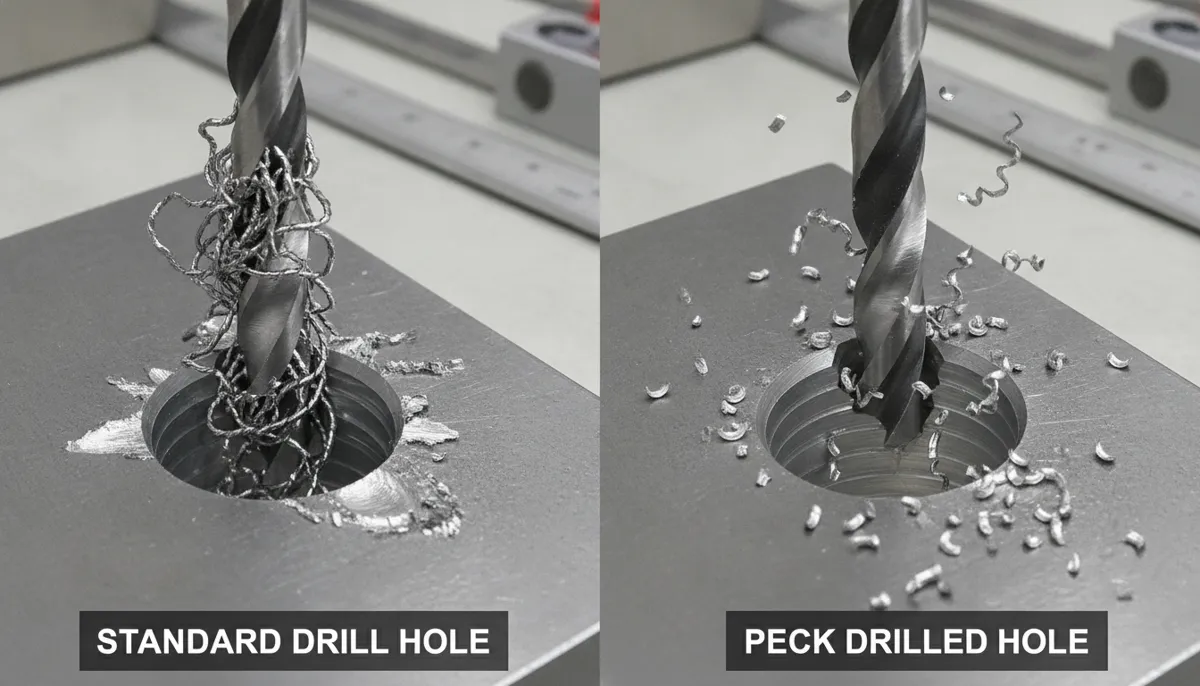
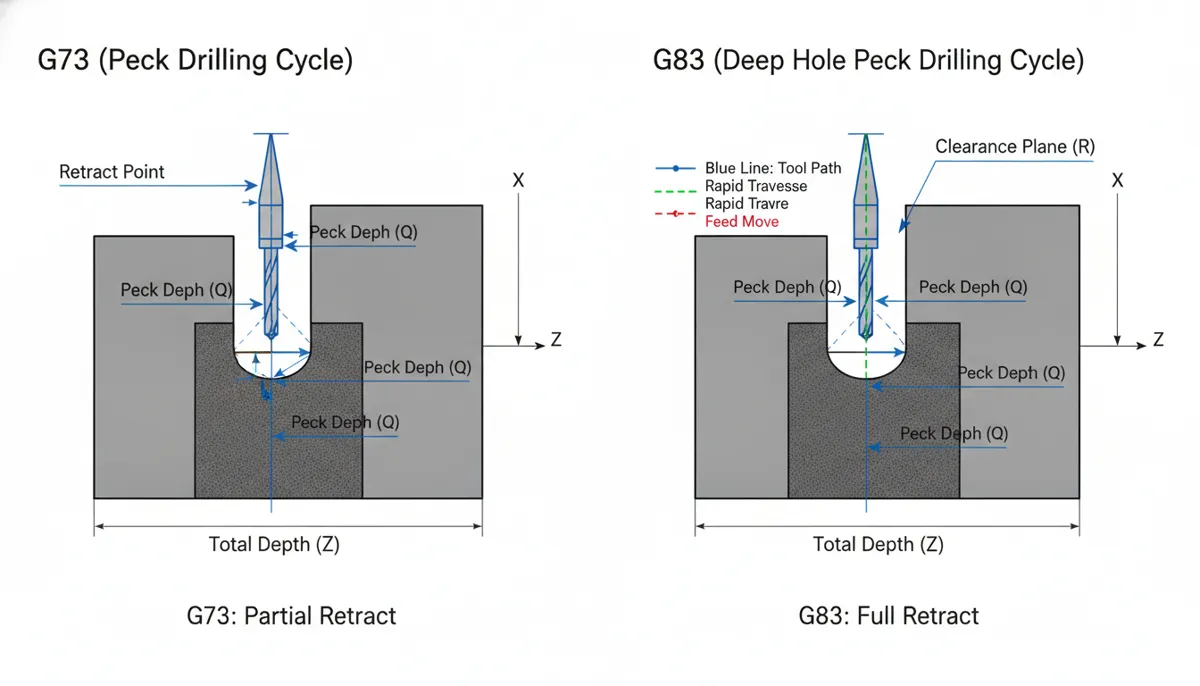
The CNC peck drilling cycle is a canned cycle (fixed cycle) in G-code programming that drills a hole in multiple incremental passes — called “pecks” — rather than plunging to full depth in one continuous motion. After each peck, the drill either partially retracts (G73) or fully retracts to a clearance plane (G83) to break the chip and flush it out of the hole with coolant. This prevents chip packing, reduces heat buildup, and dramatically extends tool life in deep or difficult-to-machine materials.
3. G73 vs G83: Core Features of CNC Peck Drilling Cycles
3.1 G73 — High-Speed Peck Drilling Cycle
G73 uses a high-speed pecking motion with a small retract (typically 0.01–0.02 inches / 0.3–0.5 mm) after each peck. This minimizes non-cutting air time while still breaking chips. G73 is ideal for shallow to medium depth holes (up to 5× drill diameter) in free-cutting materials like aluminum, mild steel, and brass. The reduced retract distance means significantly faster cycle times compared to G83.
Fanuc G73 syntax:
G73 X___ Y___ Z___ R___ Q___ F___ ;
Where: Q = peck depth (incremental, always positive), R = retract plane height, F = feed rate. Cancel with G80.
3.2 G83 — Deep Hole Peck Drilling Cycle
G83 retracts the drill fully to the R-plane (clearance plane) after every peck, ensuring complete chip evacuation and coolant flush. This is essential for deep holes (greater than 3× drill diameter), tough materials like stainless steel and titanium, and any application where chip packing is a risk. The trade-off is longer cycle time due to full retract travel.
Fanuc G83 syntax:
G83 X___ Y___ Z___ R___ Q___ F___ ;
Parameters are identical to G73. The key difference is the retract behavior — G83 always returns to the R-plane, G73 only retracts by a small fixed amount.
4. Comparison: G73 vs G83 Peck Drilling Cycles
| Feature | G73 (High-Speed Peck) | G83 (Deep Hole Peck) |
|---|---|---|
| Retract after each peck | Small (0.01–0.02 in / 0.3–0.5 mm) | Full retract to R-plane |
| Best for hole depth | Up to 5× drill diameter | Any depth, especially >3× diameter |
| Cycle time | Fast — minimal retract travel | Slower — full retract each peck |
| Chip evacuation | Good for short chips | Excellent — full flush each cycle |
| Tool life improvement | 20–30% vs continuous drilling | 40–60% vs continuous drilling |
| Best materials | Aluminum, mild steel, brass | Stainless steel, titanium, hardened steel |
| Controller compatibility | Fanuc, Siemens, Heidenhain | All major CNC controllers |
| Recommended peck depth (Q) | 0.2–0.5× drill diameter | 0.1–0.3× drill diameter |
5. Real-World Use Cases for the CNC Peck Drilling Cycle
5.1 Deep Hole Drilling in Aerospace Components — USA
A Tier 1 aerospace supplier in Ohio faced frequent drill breakage when machining 250 mm deep holes in Ti-6Al-4V titanium alloy landing gear components. By switching to the G83 CNC peck drilling cycle with a peck depth of 0.5× drill diameter and through-spindle coolant, they reduced tool breakage by 60% and improved hole straightness to within ±0.02 mm. Annual tooling cost savings exceeded $72,000.
“We were snapping drills every other hour on our titanium deep-hole jobs. After implementing G83 with the parameters QiaoFeng recommended, we’ve gone weeks without a single breakage. The chip evacuation is night and day compared to what we were doing before.”
5.2 High-Speed Aluminum Drilling for Automotive Production — Germany
A Tier 1 automotive supplier in Bavaria needed to drill 5,000 holes per shift in aluminum engine block castings. Using the G73 high-speed peck drilling cycle with a peck depth of 0.2 inches and a 0.02-inch retract, they achieved a 30% reduction in cycle time while maintaining Ra surface finish below 1.6 µm. The optimized Q value balanced speed with reliable chip breaking across all three production shifts.
“Switching from continuous drilling to G73 peck cycle cut our per-hole cycle time from 4.2 seconds to 2.9 seconds. On 5,000 holes a shift, that adds up to nearly two extra hours of capacity per day. QiaoFeng’s parameter guidance made the transition seamless.”
5.3 Hardened Steel Mold Drilling — Vietnam
A precision mold manufacturer in Ho Chi Minh City struggled with chip welding and inconsistent hole tolerances when drilling 60 HRC tool steel. Implementing the G83 CNC peck drilling cycle with a dwell at the bottom of each peck allowed chips to break cleanly before retract. The result was a 50% increase in tool life and consistent hole tolerances within ±0.025 mm, meeting their export customers’ drawing requirements.
“Hardened steel drilling used to be our biggest headache — chips welding to the flutes, oversized holes, broken drills. The G83 peck cycle with a bottom dwell solved all three problems at once. Our scrap rate on mold plates dropped from 12% to under 2%.”
✅ Advantages of Peck Drilling
- Dramatically reduces tool breakage risk
- Improves chip evacuation in deep holes
- Extends drill tool life by 20–60%
- Improves hole straightness and finish
- Reduces heat buildup in difficult materials
- Simple G-code implementation (G73/G83)
- Compatible with all major CNC controllers
❌ Limitations to Consider
- G83 increases cycle time by 20–30%
- Q value must be tuned per material
- Not necessary for shallow holes (<2× diameter)
- Requires coolant for best results in deep holes
- Wrong peck depth can cause work hardening
6. Frequently Asked Questions
What is the difference between G73 and G83 in the CNC peck drilling cycle?
G73 performs a high-speed peck with a small retract (0.01–0.02 inches) after each peck, making it faster for shallow holes in soft materials. G83 retracts fully to the R-plane after each peck, ensuring complete chip evacuation — critical for deep holes or materials that produce long, stringy chips like stainless steel and titanium. Use G73 for speed in non-critical applications; use G83 for reliability in deep or difficult holes.
Can I use the peck drilling cycle for all materials?
The CNC peck drilling cycle benefits most materials, but parameters must be adjusted. For soft materials like aluminum, use deeper pecks (0.5–1× diameter) with G73. For hard or stringy materials like stainless steel, use shallower pecks (0.1–0.3× diameter) with G83 to prevent work hardening and chip packing. Always verify with your cutting tool manufacturer’s recommendations for the specific grade.
What peck depth (Q value) should I use for a 12 mm drill in steel?
Start with Q = 2–3 mm (approximately 0.2× drill diameter) for G83 in medium carbon steel. Adjust based on chip formation: if chips are long and stringy, reduce Q by 0.5 mm increments; if chips are small and powdery, you can increase Q for faster cycle time. Monitor spindle load — if it spikes during retract, chips are packing and Q needs to be reduced.
Does the peck drilling cycle significantly increase cycle time?
Compared to continuous drilling, peck drilling does add cycle time due to retract moves. For G73, the increase is minimal (5–10%) because the retract distance is very small. G83 can add 20–30% more time per hole due to full retract travel. However, in deep hole applications, the elimination of tool breakage and rework almost always results in a net productivity gain.
How do I program G73 and G83 on a Fanuc control?
For G73: G73 X___ Y___ Z___ R___ Q___ F___ ; — Q is the peck depth (incremental, positive value), R is the retract plane height above the workpiece. For G83: G83 X___ Y___ Z___ R___ Q___ F___ ; — same parameters, but the cycle retracts to the R-plane after every peck. Always cancel the canned cycle with G80 after the last hole. Refer to your specific Fanuc series manual for modal behavior differences.
What are QiaoFeng’s warranty and return policies?
All QiaoFeng CNC machines come with a 2-year warranty covering manufacturing defects and quality-related issues. Refunds are supported for verified quality problems. Returns without a quality-related reason are not accepted. Our after-sales engineering team in Dongguan provides remote diagnostics and on-site support throughout the warranty period.
Optimize Your Drilling Operations with QiaoFeng
Get expert advice on G73 & G83 parameter setup for your specific material and machine. Our engineers respond within 24 hours. Trusted by 750+ clients across the USA, Europe, and Southeast Asia since 2010.
References
- Mordor Intelligence, Machining Centers Market Size, Share & Growth Trends Report, 2024. View Report →
- Elsevier, Journal of Manufacturing Processes, Vol. 64, 2021 — “Tool wear and hole quality in peck drilling of titanium alloys.” View Article →
- Springer, International Journal of Advanced Manufacturing Technology, Vol. 109, 2020 — “Effect of chip evacuation strategy on tool life in deep hole drilling.” View Article →