Choosing between an open loop and a closed loop CNC system is one of the most consequential decisions in CNC machine specification and retrofit planning. The difference is not merely technical — it directly determines your scrap rate, tool life, part repeatability, and ultimately your cost per part. An open loop system commands the motor to move and assumes it complied. A closed loop CNC system commands the motor, then verifies through encoder feedback that the move actually happened — and corrects any deviation in real time. For precision machining applications, this distinction separates acceptable from unacceptable. At QiaoFeng CNC, founded in 2010 in Dongguan, Guangdong, we have helped 750+ customers across Europe, North America, and Southeast Asia specify, configure, and retrofit CNC systems — including closed loop servo upgrades for precision aerospace, mold, and high-speed routing applications. This guide covers the complete technical comparison, encoder types, real-world use cases, and a practical decision framework for choosing the right system for your application.
1. Why Closed Loop CNC System Adoption Is Accelerating
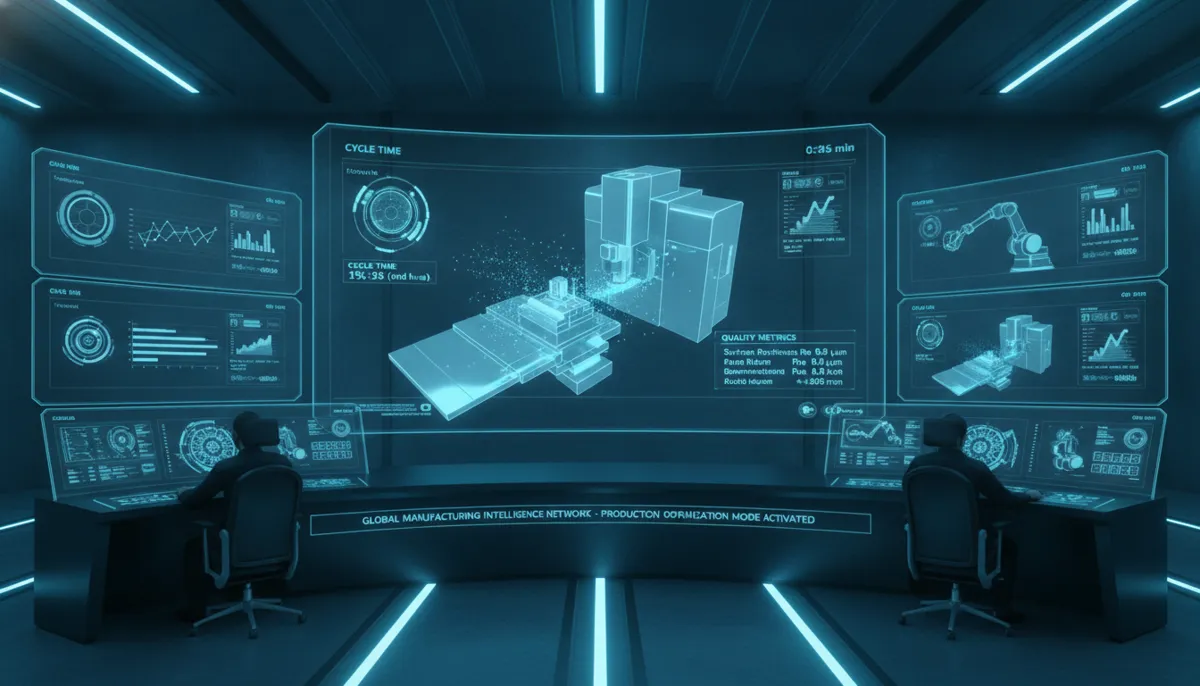
The global CNC machine market is undergoing a fundamental shift toward higher precision and greater automation — both of which favor closed loop servo technology over open loop stepper systems. According to Mordor Intelligence’s Computer Numerical Controls (CNC) Market Report, the global CNC controls market is valued at USD 116.57 billion in 2026 and is projected to grow steadily through 2031, driven by demand for higher accuracy, automation integration, and Industry 4.0 connectivity — all of which require closed loop feedback architecture.
Meanwhile, Grand View Research’s Servo Motor Market Report values the global servo motor and drive market at USD 16.32 billion in 2023, projected to grow at a CAGR of 6.2% through 2030, with CNC machine tools identified as the largest single end-use segment. This growth directly reflects the industry-wide migration from open loop stepper systems to closed loop servo systems in precision manufacturing. According to MarketsandMarkets, the CNC machine market is projected to reach USD 80.4 billion by 2028, with servo-driven closed loop systems now the standard specification for any machine targeting tolerances below ±0.01mm.
2. How a Closed Loop CNC System Works: Core Principles
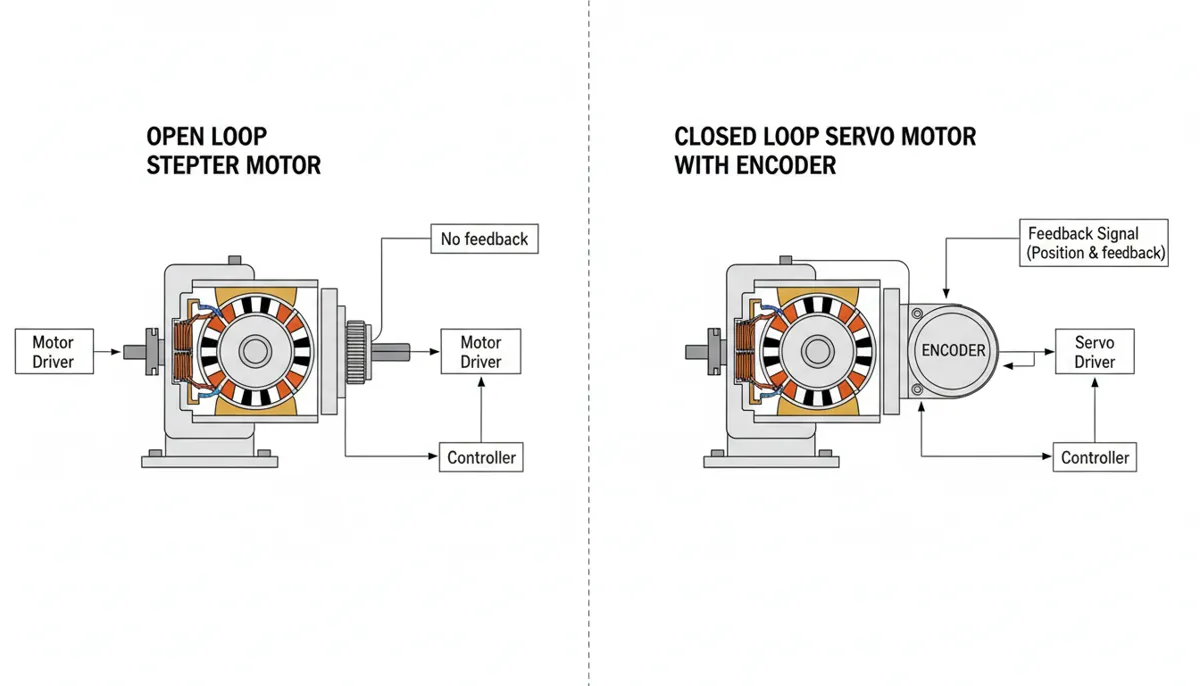
Understanding the operating principle of a closed loop CNC system is essential for evaluating whether it is the right choice for your application. The system operates as a continuous feedback control loop with four key elements:
- Command Signal — The CNC controller sends a position or velocity command to the servo drive.
- Servo Motor Execution — The servo motor moves in response to the drive’s output.
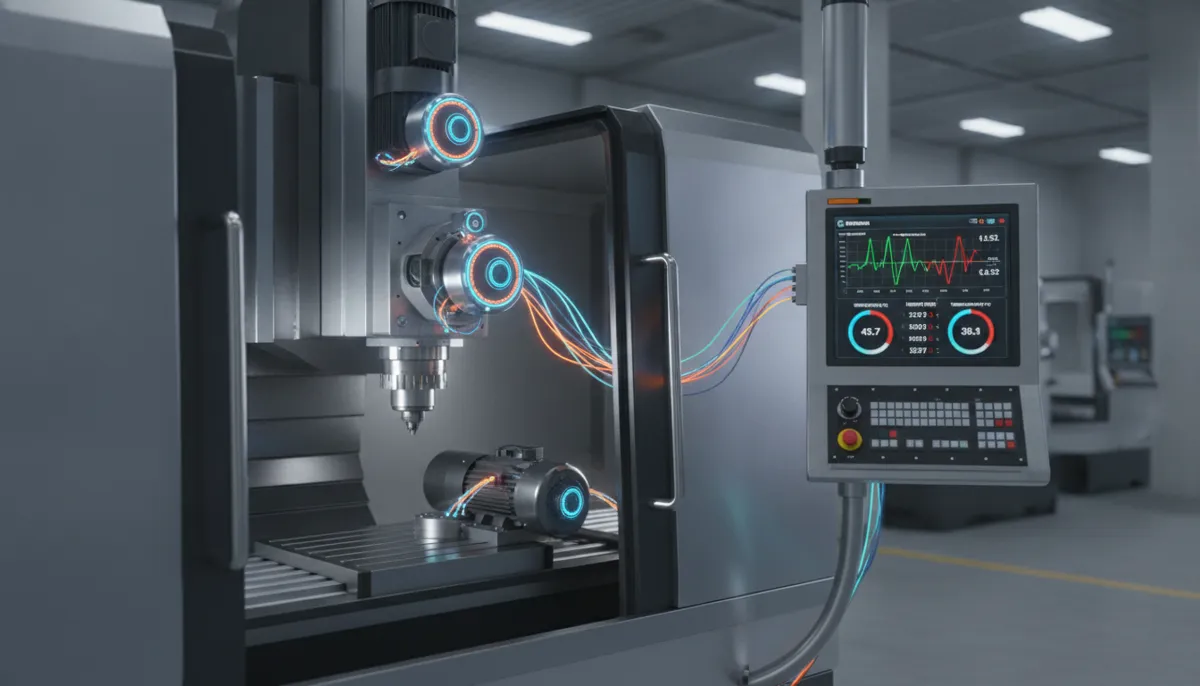
- Encoder Feedback — A rotary or linear encoder attached to the motor shaft or machine axis continuously measures actual position and velocity, reporting back to the controller.
- Error Correction — The controller compares commanded position to actual position. Any deviation (following error) triggers an immediate corrective signal to the drive. This loop runs at update rates of 1,000–4,000 Hz — thousands of corrections per second.
The result is a system that actively compensates for load variations, acceleration forces, thermal drift, and mechanical compliance — maintaining commanded position regardless of external disturbances. Open loop stepper systems have no step 3 or step 4: they command a move and have no mechanism to detect or correct for missed steps.
3. Encoder Types in Closed Loop CNC Systems
The encoder is the heart of any closed loop CNC system. The type of encoder selected determines the system’s accuracy ceiling, resolution, and behavior after power loss. There are two primary categories:
3.1 Rotary Encoders (Motor-Mounted)
Rotary encoders are attached to the servo motor shaft and measure motor rotation. They are the most common encoder type in CNC servo systems. Within rotary encoders, there are two critical subtypes:
- Incremental Encoders — Generate pulses as the shaft rotates. The controller counts pulses to determine relative position from a known reference. After power loss, the machine must re-home to re-establish the reference position. Resolution is typically 2,500–10,000 pulses per revolution (PPR), with interpolation reaching effective resolutions of 0.001mm or better. Most cost-effective option for general CNC applications.
- Absolute Encoders — Output a unique digital code for every shaft position across the full range of travel. The controller always knows exact position — even after power loss, without re-homing. Essential for applications where re-homing after power interruption is unacceptable (e.g., large gantry machines, medical devices, aerospace fixtures). Higher cost but eliminates re-homing downtime entirely.
3.2 Linear Encoders (Scale-Mounted)
Linear encoders are mounted directly on the machine axis — on the ballscrew carriage or linear guide — and measure actual linear position of the axis, bypassing the ballscrew entirely. This eliminates ballscrew pitch error, thermal expansion of the screw, and backlash from the feedback loop. Linear encoders are the highest-accuracy option for closed loop CNC systems, achieving resolutions of 0.1–1.0 µm, and are standard on precision jig borers, coordinate measuring machines, and high-accuracy machining centers. The trade-off is higher cost and more complex installation compared to rotary encoders.
4. Core Features of a Closed Loop CNC System
4.1 Real-Time Position Feedback and Error Correction
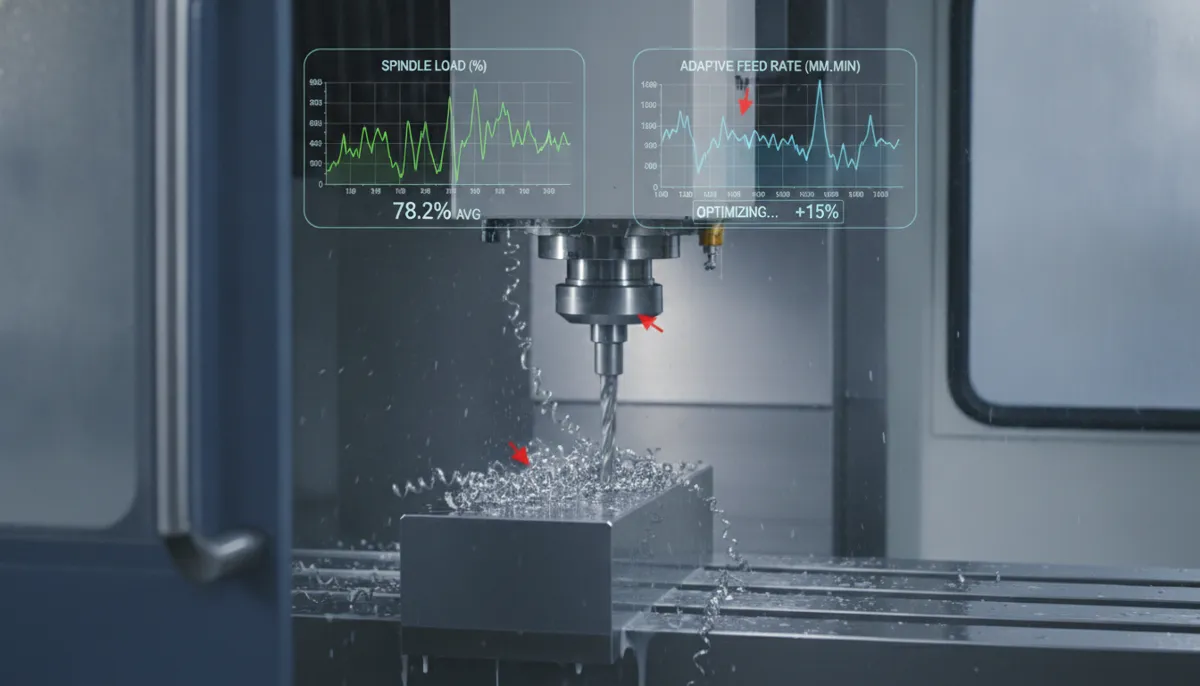
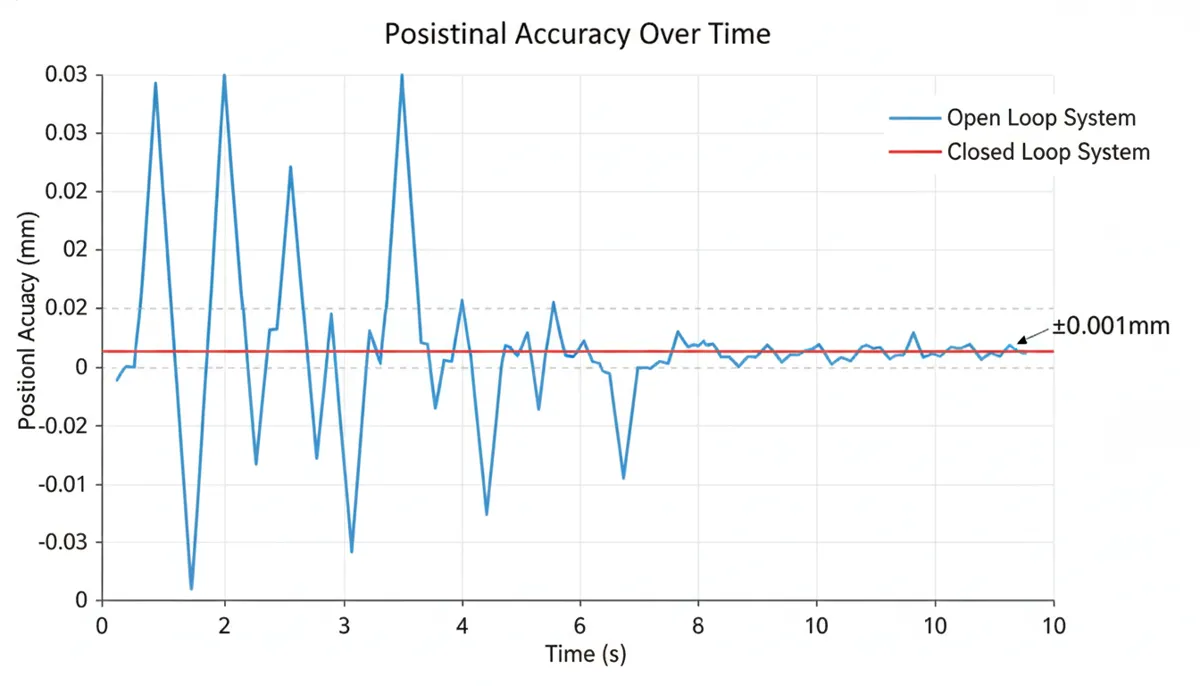
Encoders continuously report actual axis position to the controller at update rates of 1,000–4,000 Hz. Any deviation between commanded and actual position — caused by cutting forces, acceleration, thermal drift, or mechanical compliance — is detected and corrected within milliseconds. This feedback loop ensures that even under variable cutting loads, such as the torque fluctuations experienced when milling hardened steel, the tool path remains accurate. In practical terms, a well-tuned closed loop CNC system maintains positional accuracy of ±0.003–0.005mm under dynamic cutting conditions — compared to open loop steppers that can accumulate errors of 0.05–0.5mm under similar loads.
4.2 High Torque Across the Full Speed Range
Servo motors in a closed loop CNC system deliver rated torque across the full speed range — from near-zero RPM to maximum speed. This is in fundamental contrast to stepper motors, which produce maximum torque at standstill and lose torque rapidly as speed increases. For CNC applications, this means servo systems maintain full cutting force capability at both low-speed tapping and high-speed contouring — without the torque drop-off that causes stepper systems to miss steps during aggressive acceleration or heavy cuts.
4.3 Automatic Stall Detection and Recovery
When a collision, tool breakage, or overload event occurs, the closed loop CNC system detects the sudden position error spike immediately — typically within 1–2 milliseconds — and triggers an emergency stop before significant damage occurs. The system logs the fault, and after the operator clears the cause, the machine can re-home and resume production. Open loop stepper systems have no equivalent capability: a collision simply causes missed steps, and the machine continues running with an unknown positional offset — often destroying the workpiece, the tool, and potentially the fixture before the operator notices.
4.4 Predictive Diagnostics and Condition Monitoring
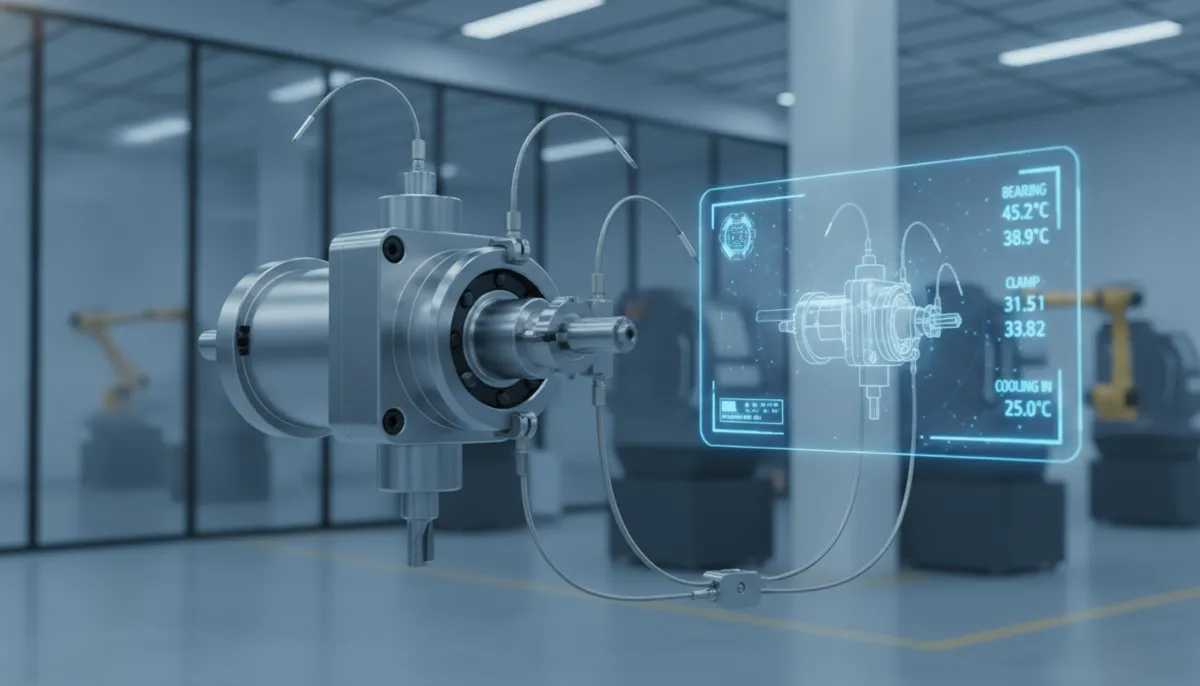
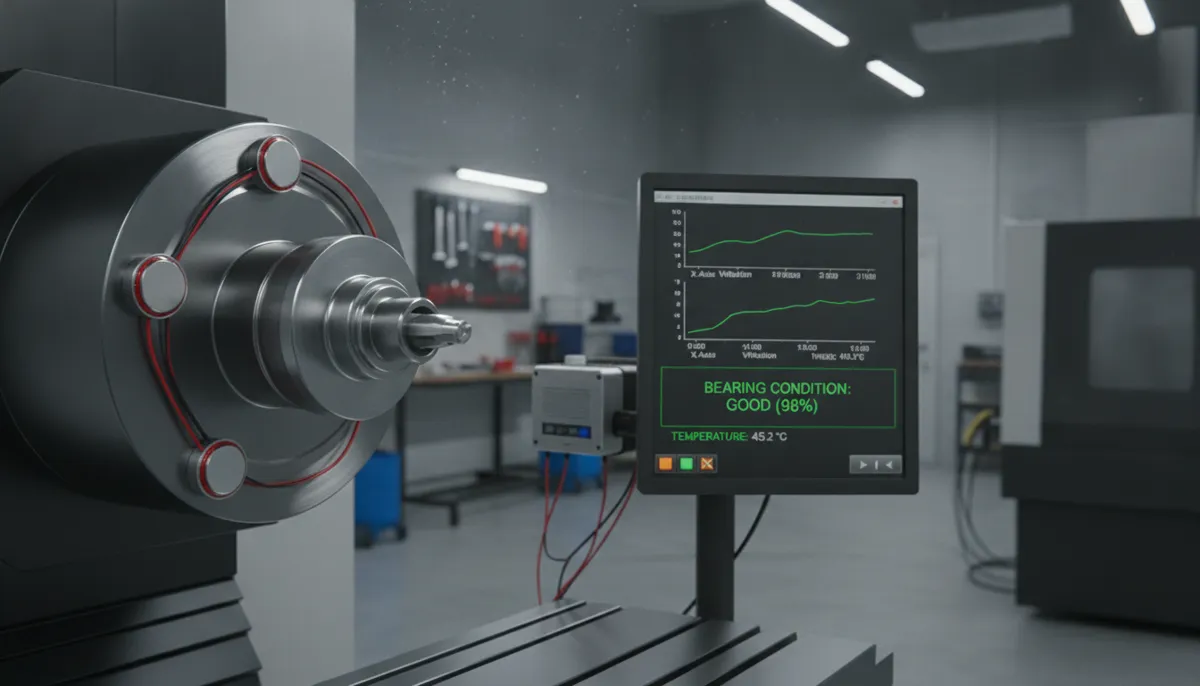
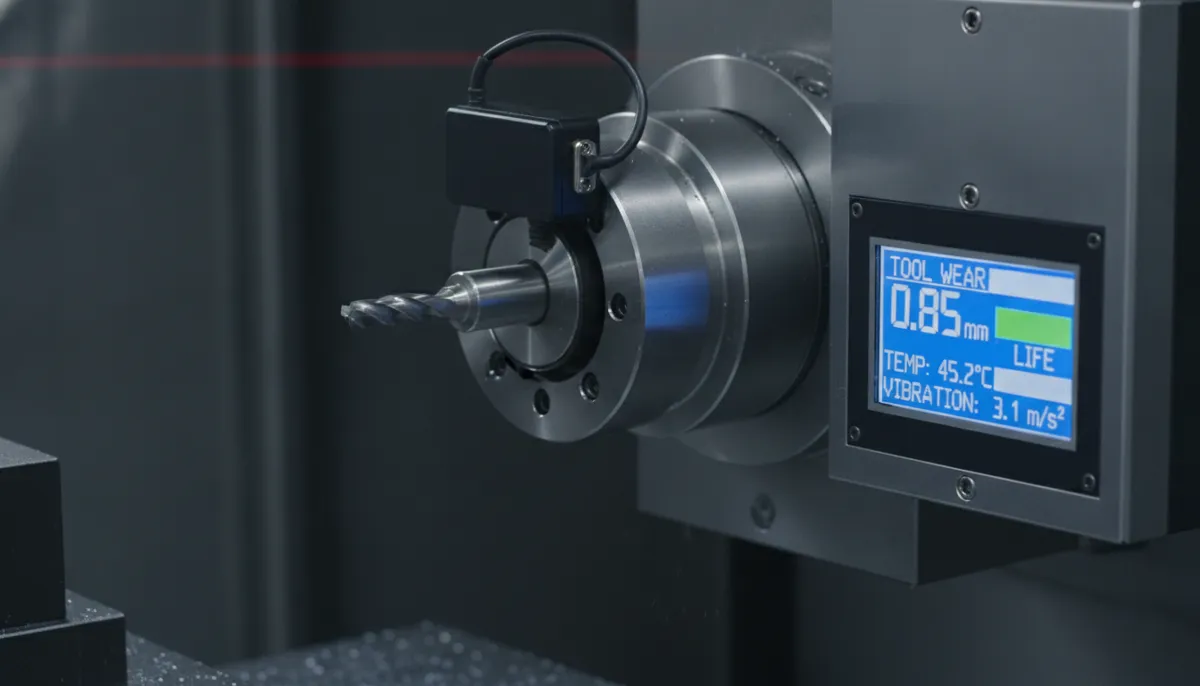
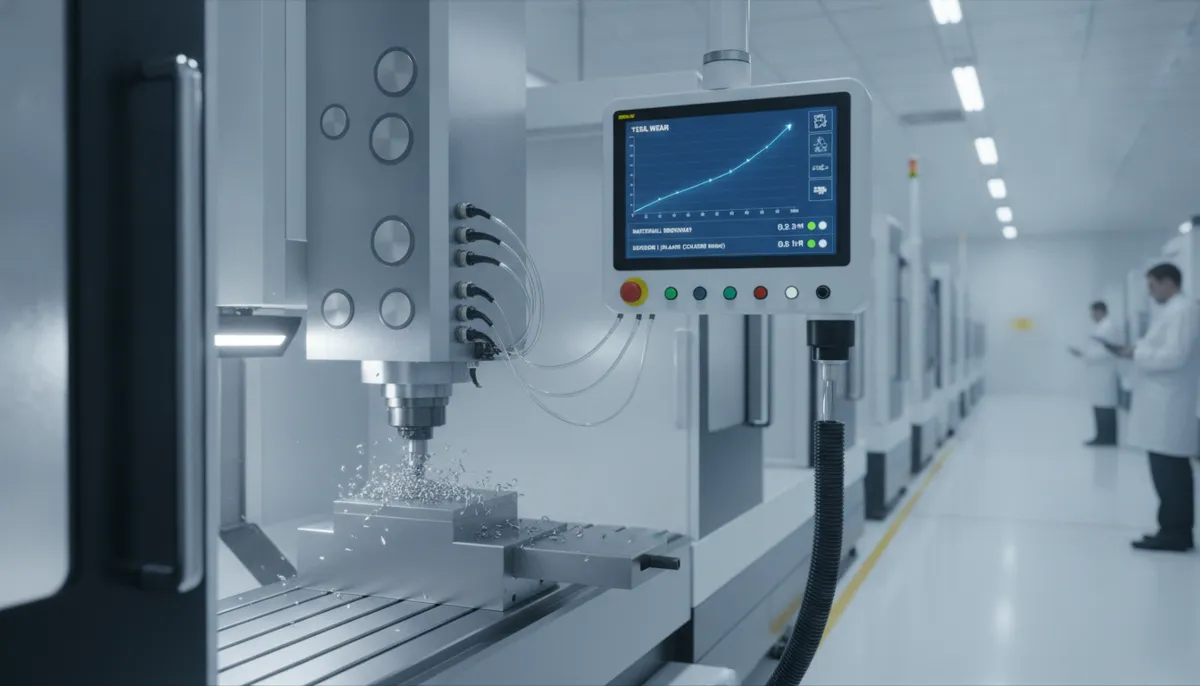
Modern servo drives in a closed loop CNC system continuously monitor motor current, following error trends, velocity ripple, and thermal state. Gradual increases in following error over time indicate ballscrew wear, bearing degradation, or lubrication issues — allowing maintenance to be scheduled before a failure occurs. This predictive capability is a significant operational advantage in production environments where unplanned downtime is costly.
5. Open Loop vs. Closed Loop CNC System: Full Comparison
| Parameter | Open Loop (Stepper) | Closed Loop CNC System (Servo) | Application Implication |
|---|---|---|---|
| Position Feedback | None — assumes commanded move completed | Continuous encoder feedback at 1,000–4,000 Hz | Closed loop detects and corrects all positional errors |
| Typical Accuracy | ±0.05–0.5mm (load dependent) | ±0.003–0.010mm | 10–100× accuracy improvement |
| Repeatability | ±0.05–0.1mm | ±0.002–0.005mm | Critical for production consistency |
| Torque vs. Speed | Torque drops sharply above ~1,000 RPM | Full rated torque across entire speed range | Servo maintains cutting force at all feed rates |
| Missed Step / Error Recovery | No detection — machine continues with offset | Immediate fault detection and stop | Prevents workpiece and machine damage |
| Power Loss Behavior | Position lost — must re-home | Incremental: re-home required; Absolute: position retained | Absolute encoders eliminate re-homing downtime |
| High-Speed Performance | Step loss risk above ~3,000 mm/min | Full accuracy maintained at 10,000–60,000 mm/min | Servo enables high-speed machining strategies |
| Diagnostic Capability | None | Following error monitoring, thermal alerts, wear detection | Enables predictive maintenance |
| Initial Cost | Lower (stepper motors less expensive) | Higher (servo motors + drives + encoders) | Closed loop ROI typically recovered in 6–18 months |
| Best For | Wood routing, plasma cutting, 3D printing, low-precision work | Precision machining, aerospace, mold & die, medical devices | Match system to tolerance requirement |
6. Real-World Use Cases for Closed Loop CNC Systems
6.1 Aerospace Component Machining
Pain point: Tight tolerances (±0.005mm) on complex titanium and aluminum geometries. Multi-hour machining cycles where thermal drift and cutting force variation accumulate into dimensional errors. Open loop stepper systems cannot maintain accuracy across long cycles under variable loads.
Solution: A closed loop CNC system with linear encoders on all axes maintains ±0.003mm accuracy throughout the full machining cycle, regardless of thermal state or cutting load variation. Absolute encoders eliminate re-homing after power interruptions — critical when a power event mid-cycle on a $2,000 titanium billet would otherwise result in a scrapped part.
6.2 High-Speed Aluminum Routing
Pain point: Open loop stepper routers lose steps during aggressive feed rates (above 3,000–5,000 mm/min), causing dimensional errors and scrapped panels. Increasing stepper current to prevent step loss generates excessive heat and reduces motor life.
Solution: A closed loop CNC system with rotary encoders maintains full accuracy at feed rates of 15,000–30,000 mm/min — far beyond the reliable operating range of stepper systems. The servo drive continuously monitors and corrects position, eliminating step loss entirely regardless of feed rate or acceleration.
6.3 Multi-Axis Mold and Die Machining
Pain point: Synchronization errors between axes in open loop systems cause surface defects on complex 3D mold surfaces — visible as witness marks, steps, or texture variations that require extensive hand polishing to correct.
Solution: A closed loop CNC system with master-slave axis synchronization and high-resolution rotary encoders maintains inter-axis position synchronization to within ±0.002mm. The result is smooth, consistent surface finish across complex 3D surfaces — dramatically reducing or eliminating hand polishing operations.
7. What Our Customers Say About Closed Loop CNC System Upgrades
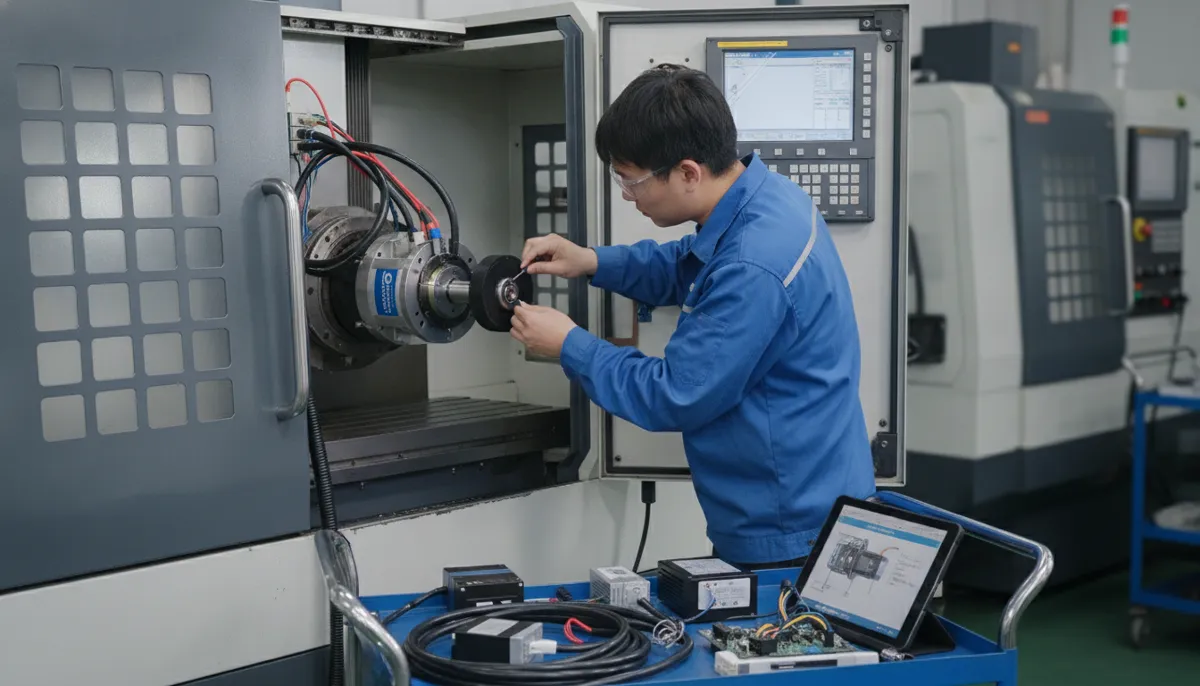
“We manufacture precision aluminum housings for automotive sensors — tolerances of ±0.005mm on bore diameters, 100% inspection required. Our previous open loop stepper system had a drift problem at high feed rates that was causing a 9% scrap rate on the bore features. After retrofitting to a closed loop servo system through QiaoFeng, scrap on those features dropped to under 1% within the first production month. The encoder feedback eliminated the drift entirely. The retrofit paid for itself in saved material costs within four months.”
“We run a high-mix job shop producing medical device housings and aerospace brackets in aluminum and stainless steel. Our old stepper-driven router was reliable for simple parts, but we kept getting step loss on complex contours at the feed rates our customers’ cycle time targets required. QiaoFeng helped us retrofit to a closed loop servo system with incremental encoders. We now run at 18,000 mm/min on aluminum contours with zero step loss and consistent Ra 0.8 µm finish. Our on-time delivery rate improved from 82% to 97% in the first quarter after the upgrade.”
“Chúng tôi sản xuất khuôn ép nhựa cho ngành điện tử và gia dụng. Trước đây, máy CNC mở vòng của chúng tôi thường xuyên gặp lỗi đồng bộ giữa các trục khi gia công bề mặt 3D phức tạp, dẫn đến các vết xước và bậc thang trên bề mặt khuôn — mỗi bộ khuôn mất 6–8 giờ đánh bóng thủ công. Sau khi nâng cấp lên hệ thống CNC vòng kín với servo và encoder, thời gian đánh bóng giảm xuống còn dưới 1 giờ mỗi bộ khuôn. Độ chính xác định vị được duy trì ổn định ở ±0.004mm qua nhiều ca sản xuất liên tiếp. Đây là khoản đầu tư có ROI rõ ràng nhất mà chúng tôi từng thực hiện.”
8. Pros & Cons: Closed Loop CNC System vs. Open Loop
✅ Advantages of Closed Loop CNC Systems
- Real-time encoder feedback corrects positional errors instantly
- ±0.003–0.010mm accuracy — 10–100× better than open loop
- Full rated torque maintained across entire speed range
- Immediate stall/collision detection prevents workpiece damage
- High-speed operation (10,000–60,000 mm/min) without step loss
- Predictive diagnostics enable planned maintenance scheduling
- Absolute encoders retain position after power loss — no re-homing
- Retrofit-compatible with most existing CNC machine frames
❌ Limitations to Consider
- Higher initial cost than open loop stepper systems (typically 20–40% more)
- More complex tuning — PID gains must be set correctly for each axis
- Encoder cables and connectors require careful routing and protection
- Incremental encoders require re-homing after power loss
- Overkill for low-precision applications (wood routing, plasma, 3D printing)
- Servo drive fault codes require trained technician to diagnose
9. FAQ: Closed Loop CNC System
What is the main advantage of a closed loop CNC system over open loop?
The primary advantage is real-time position feedback and error correction. An open loop stepper system commands a move and assumes the motor complied — it has no mechanism to detect missed steps caused by overload, acceleration forces, or electrical noise. A closed loop CNC system uses encoders to continuously verify actual axis position and corrects any deviation within milliseconds. The practical result is 10–100× better positional accuracy, elimination of step loss at high feed rates, immediate collision detection, and predictive maintenance capability — none of which are available in open loop systems.
Can I retrofit my existing open loop CNC machine to a closed loop system?
Yes — most open loop CNC machines can be retrofitted to a closed loop CNC system. A typical retrofit involves replacing stepper motors with servo motors and drives, adding rotary or linear encoders to each axis, and upgrading or reconfiguring the CNC controller to accept encoder feedback. QiaoFeng’s engineering team has completed retrofit projects on a wide range of machine types and controller platforms, including Mach3, LinuxCNC, Siemens, and Fanuc-based systems. Retrofit scope and timeline depend on machine size, axis count, and controller compatibility — contact us for a free retrofit assessment.
Is a closed loop CNC system always better for accuracy?
For applications requiring tolerances tighter than ±0.01mm, a closed loop CNC system is essentially mandatory — open loop steppers cannot reliably achieve this accuracy under dynamic cutting conditions. However, for lower-precision applications such as wood routing, foam cutting, plasma cutting, or hobby 3D printing where tolerances of ±0.1–0.5mm are acceptable, open loop stepper systems are a cost-effective choice. The decision should be driven by your tightest tolerance requirement, your feed rate targets, and the cost of scrap in your application — not by a blanket preference for one technology.
What is the difference between incremental and absolute encoders in a closed loop CNC system?
Incremental encoders generate position pulses relative to a reference point established at power-on (machine home). After any power interruption, the machine must re-home before resuming production. They are the most common and cost-effective encoder type for general CNC applications. Absolute encoders output a unique position code for every point in the axis travel range — the controller always knows exact position, even after power loss, without re-homing. Absolute encoders are preferred for large machines where re-homing is time-consuming, for applications where power interruptions are frequent, and for any situation where resuming mid-cycle after a power event is required.
How does a closed loop CNC system affect maintenance requirements?
A closed loop CNC system significantly improves maintenance management compared to open loop. Servo drives continuously monitor following error trends, motor current draw, velocity ripple, and thermal state. Gradual degradation in these parameters — caused by ballscrew wear, bearing deterioration, lubrication breakdown, or encoder contamination — is detectable weeks or months before a failure occurs, enabling planned maintenance rather than emergency repair. This predictive capability is one of the most valuable operational benefits of closed loop architecture in production environments where unplanned downtime carries significant cost.
What is QiaoFeng’s warranty and refund policy for CNC systems?
All QiaoFeng CNC machines and retrofit systems come with a 2-year warranty covering manufacturing defects and verified quality issues. If a confirmed quality problem is identified, we support full refunds or replacement. We do not offer no-reason returns for correctly functioning systems. Our after-sales team provides technical support, spare parts supply, and application engineering assistance throughout the warranty period. Contact us for full warranty terms and a free closed loop retrofit assessment.
Ready to Upgrade to a Closed Loop CNC System?
Eliminate step loss, reduce scrap, and achieve micron-level accuracy. QiaoFeng provides closed loop servo systems and retrofit solutions backed by 15 years of experience, 750+ global customers, and a 2-year warranty.
References
- Mordor Intelligence. Computer Numerical Controls (CNC) Market Size & Share Analysis, 2026–2031. https://www.mordorintelligence.com/industry-reports/computer-numerical-controls-market
- Grand View Research. Servo Motor Market Size, Share & Trends Analysis Report, 2024–2030. https://www.grandviewresearch.com/industry-analysis/servo-motor-market
- MarketsandMarkets. CNC Machine Market Size, Share and Industry Report, 2023–2028. https://www.marketsandmarkets.com/Market-Reports/cnc-market-195192631.html
- Mordor Intelligence. Machining Centers Market Size, Share & Growth Trends Report, 2026–2031. https://www.mordorintelligence.com/industry-reports/machining-centers-market
- Omron Industrial Automation. Servo Systems Technical Guide: Closed Loop Control Fundamentals. https://industrial.omron.us/en/solutions/motion-control/servo-systems