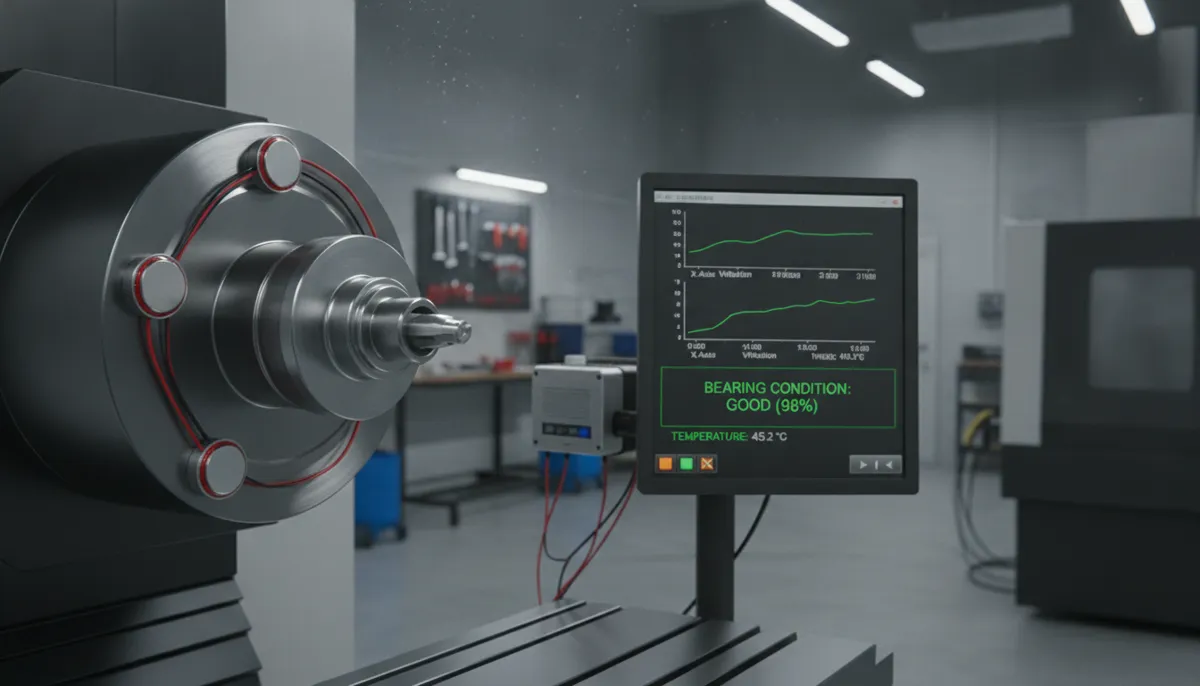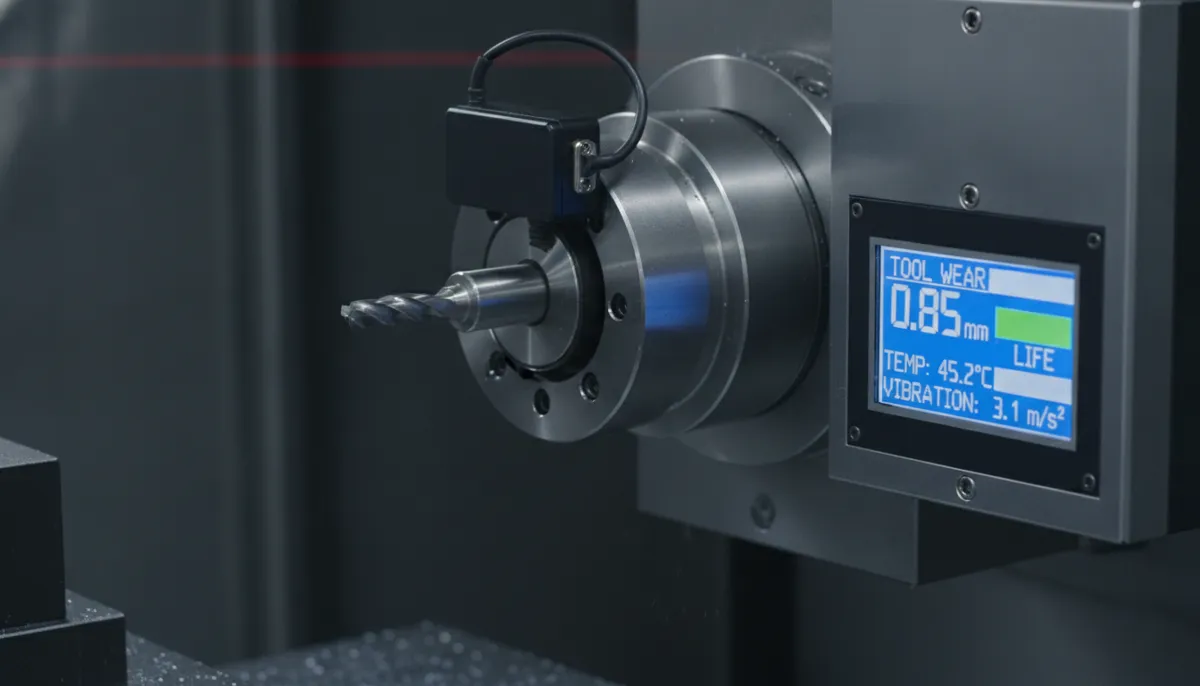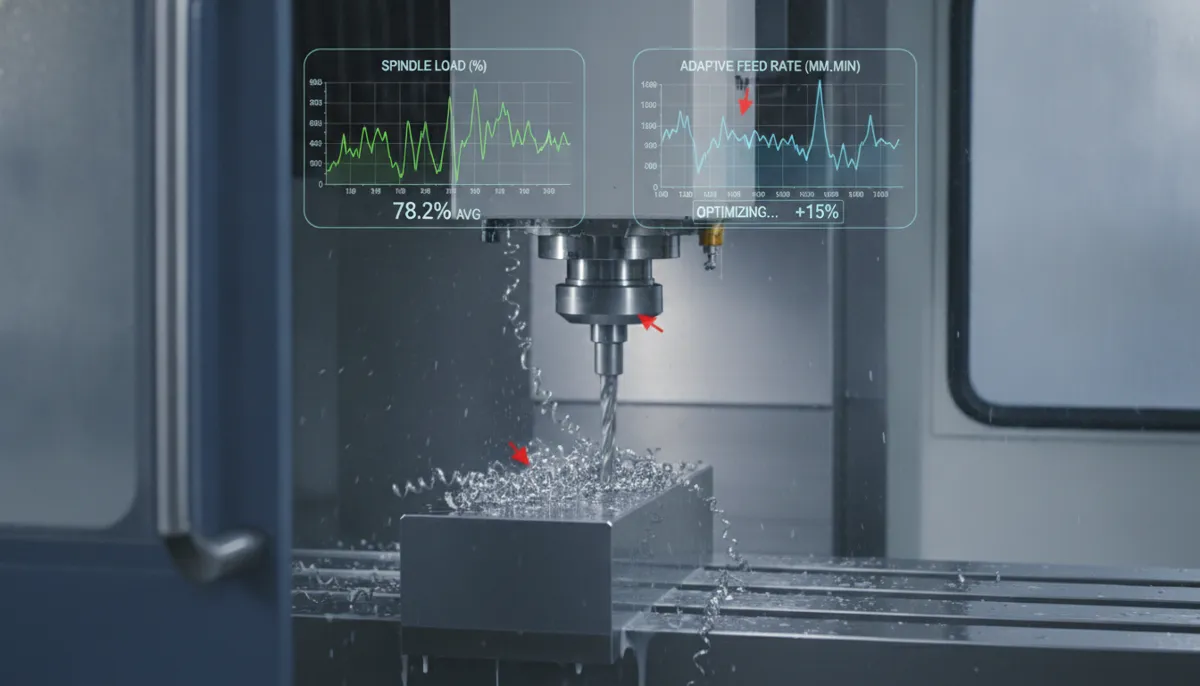
CNC cycle time is one of the most critical metrics in precision manufacturing — it directly determines your cost per part, machine utilization, and ability to compete on price and delivery. Whether you are running a high-mix job shop or a dedicated production cell, understanding how to calculate and reduce CNC cycle time is the fastest path to improving profitability. At QiaoFeng Intelligent Equipment, founded in 2010 and based in Dalingshan, Dongguan, Guangdong, China, we have helped 750+ manufacturers across the US, Europe, and Southeast Asia achieve measurable cycle time reductions — in one documented case, cutting cycle time by 22% and saving over $45,000 annually. This guide covers everything: definition, calculation formula, optimization strategies, and real-world results.
Why CNC Cycle Time Directly Impacts Your Bottom Line
The global CNC market is projected to reach USD 116.57 billion in 2026, growing at a CAGR of 7.96% through 2031, driven by demand for faster, more precise production across aerospace, automotive, and medical sectors [1]. In this environment, cycle time efficiency is a direct competitive differentiator.
Yet most manufacturers are leaving significant capacity on the table. Industry benchmark data shows that average OEE (Overall Equipment Effectiveness) across discrete manufacturing sits at just 60–66.8% — far below the world-class threshold of 85% [2]. A separate global OEE study covering 50+ countries found that only 6% of manufacturing organizations achieve world-class OEE scores of 85% or above, with most facilities averaging 55–65% [3]. Excessive CNC cycle time — driven by unoptimized tool paths, conservative cutting parameters, and manual non-cutting activities — is one of the primary contributors to this gap.
The precision turned parts segment, where CNC operations command a 65.88% market share and are projected to grow at 8.41% CAGR, underscores how central cycle time optimization is to staying competitive in high-volume precision work [4].
1. What Is CNC Cycle Time? Definition and Key Components
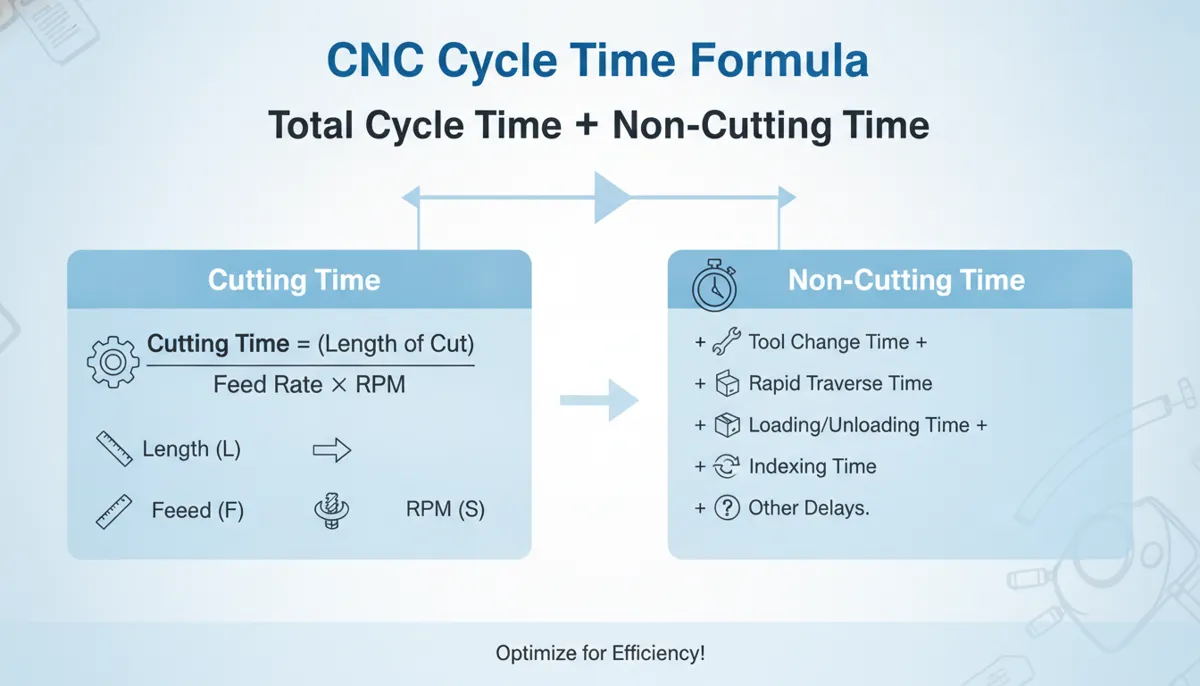
CNC cycle time is the total time required to complete one full machining operation on a single part — from the moment the CNC program starts to the moment the finished part is ready for unloading. It is a machine-centric metric that captures every second the machine is occupied with that part, whether cutting or not.
CNC cycle time consists of two fundamental components:
- Cutting Time (Spindle-On Time): The time the tool is actively removing material — drilling, milling, turning, boring. This is determined by spindle speed (RPM), feed rate (mm/min or IPM), depth of cut, and total tool path length.
- Non-Cutting Time: All time the machine is occupied but not cutting — rapid traverse moves between features, automatic tool changes (ATC), workpiece loading/unloading, probing cycles, and program pauses.
CNC Cycle Time vs. Takt Time: Key Difference
These two terms are frequently confused but measure fundamentally different things:
- CNC Cycle Time is machine-centric — how long it actually takes to produce one part.
- Takt Time is customer-centric — the maximum allowable time per part to meet customer demand, calculated as: Available Production Time ÷ Customer Demand Rate.
If your cycle time exceeds your takt time, you cannot meet customer demand without overtime, additional shifts, or extra machines. Closing this gap is the core objective of cycle time optimization.
2. How to Calculate CNC Cycle Time: Formula and Example
Accurate CNC cycle time calculation is the foundation of any process improvement effort. The standard formula is:
Where:
• Cutting Time = Tool Path Length ÷ Feed Rate (per operation, summed across all tools)
• Non-Cutting Time = Rapid Traverse Time + ATC Time + Load/Unload Time + Probing Time
• Takt Time = Available Production Time ÷ Customer Demand (units/period)
Worked Example: QiaoFeng VMC-850 Drilling Operation
Consider a simple aluminum bracket with 8 drilled holes on a QiaoFeng VMC-850:
- Cutting time (all drilling operations): 2.5 minutes
- Rapid traverse between features: 0.3 minutes
- Automatic tool changes (×3): 0.09 minutes (3 × 1.8 sec)
- Workpiece load/unload: 0.4 minutes
- Total Cycle Time = 2.5 + 0.3 + 0.09 + 0.4 = 3.29 minutes per part
If customer demand requires 200 parts per 8-hour shift, takt time = 480 ÷ 200 = 2.4 minutes. With a cycle time of 3.29 minutes, this shop cannot meet demand on a single machine — a clear signal that cycle time reduction or capacity addition is needed.
3. CNC Cycle Time Benchmarks: QiaoFeng VMC-850 vs. Industry Average
The following data compares QiaoFeng VMC-850 performance against unoptimized industry averages, based on QiaoFeng internal production records (2024) and published OEE benchmark studies.
| Metric | QiaoFeng VMC-850 (Optimized) | Industry Average (Unoptimized) |
|---|---|---|
| Typical Cycle Time Reduction vs. Baseline | 18–30% | 0% (baseline) |
| Tool Change Time (chip-to-chip) | 1.8 seconds | 3.5–5.0 seconds |
| Rapid Traverse Speed | 36 m/min | 20–24 m/min |
| Spindle Acceleration to Max RPM | ≤ 1.2 seconds | 2.5–4.0 seconds |
| Work Offset Probing | Automated (12 sec) | Manual (2–5 min) |
| Pallet Change Time | 8 seconds | 15–25 seconds |
| Achievable OEE | 80–88% | 55–67% |
| Non-Cutting Time as % of Cycle | ~18% | 35–50% |
4. CNC Cycle Time Reduction Strategies: 5 Proven Methods
Strategy 1 — Optimize Cutting Parameters
Many shops run conservative feeds and speeds inherited from older programs or cautious programmers. Systematically increasing spindle speed and feed rate — within tool manufacturer recommendations and material limits — is the fastest way to reduce cutting time. Use high-feed end mills, advanced PVD-coated inserts, and high-pressure coolant to push parameters safely. A 20% increase in feed rate directly translates to a 20% reduction in cutting time for that operation.
Strategy 2 — Minimize Non-Cutting Time
Non-cutting time is often the most overlooked source of cycle time waste. Key reductions include: shortening rapid traverse paths in CAM (avoid unnecessary Z retracts), using simultaneous 3-axis rapids, upgrading to a faster ATC (1.8 sec vs. 5 sec per change saves 3.2 sec × every tool change in every cycle), and implementing automated work offset probing to eliminate manual measurement pauses.
Strategy 3 — Improve Workholding for Multi-Part Cycles
Tombstone fixtures and multi-vise setups allow multiple parts to be machined in a single cycle, amortizing the non-cutting overhead (load/unload, probing, tool changes) across more parts. A tombstone holding 4 parts reduces effective per-part non-cutting time by up to 75% compared to single-part fixturing.
Strategy 4 — Apply CAM Simulation and Tool Path Optimization
Modern CAM software (Mastercam, Hypermill, Fusion 360) can simulate cycle time before any metal is cut. Use trochoidal milling, high-efficiency milling (HEM) strategies, and optimized entry/exit moves to eliminate air cutting. Simulation also prevents costly collisions that halt production. QiaoFeng engineers routinely achieve 15–25% cycle time reductions through CAM re-programming alone, before any hardware changes.
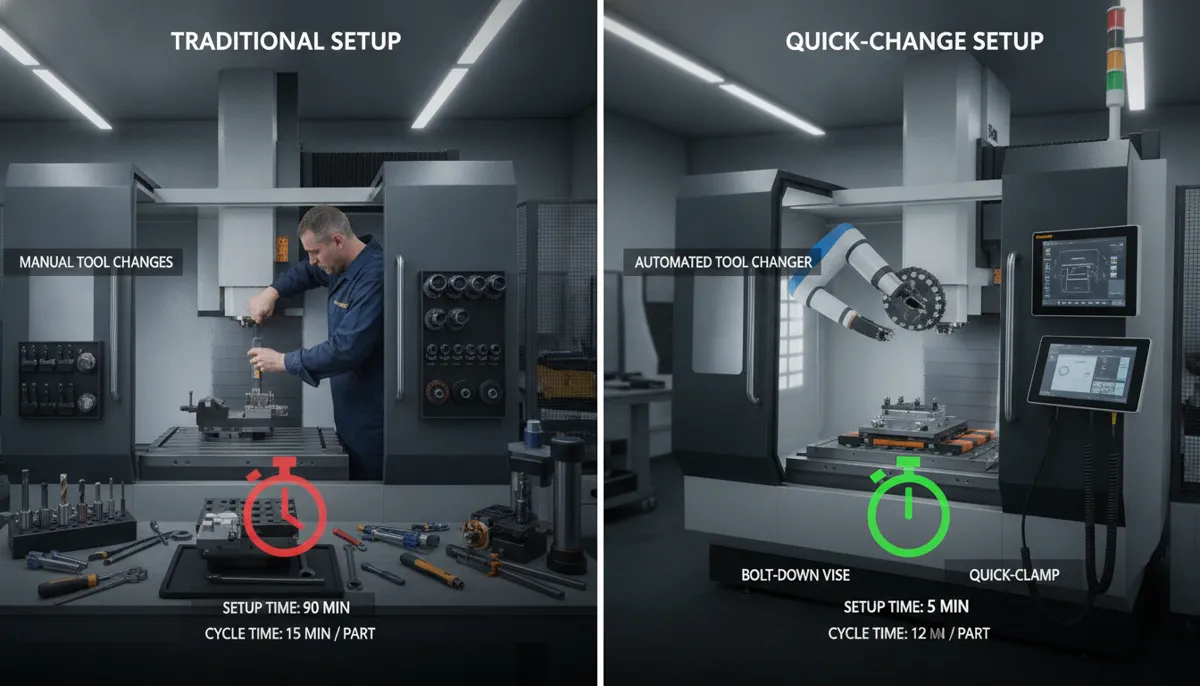
Strategy 5 — Implement Lean and SMED Principles
While SMED primarily targets setup time, its discipline of separating value-added from non-value-added time applies equally to cycle time analysis. Apply 5S to the machine environment, standardize tooling assemblies, and use pre-set tool lengths to eliminate in-cycle measurement. Every second of non-cutting time eliminated inside the cycle directly reduces cost per part.
5. Real-World Case Studies: CNC Cycle Time Reduction Results
Case 1 — Automotive Lighting Bracket, Guangdong (8.2 min → 6.4 min)
A precision machining shop in Guangdong was producing complex aluminum brackets for automotive lighting assemblies with a cycle time of 8.2 minutes per part. Three bottlenecks were identified: excessive air cutting in the CAM tool path, conservative spindle speed (10,000 RPM vs. achievable 12,000 RPM), and a manual tool change routine adding 45 seconds per cycle. After implementing a new high-efficiency CAM strategy, increasing spindle speed to 12,000 RPM, and installing a quick-change tooling system, cycle time dropped to 6.4 minutes — a 22% reduction. Annual savings exceeded $45,000, and the shop won three new contracts within six months by offering faster delivery at lower per-part cost.
“We were losing quotes on aluminum structural parts because our cycle time was too high. QiaoFeng’s engineers came in, re-ran our CAM strategy, and pushed our spindle from 10K to 12K RPM with the right tooling. Cycle time dropped 22% in two weeks. We’ve since won three new contracts we couldn’t have touched before. The ROI was immediate.”
Case 2 — Aerospace Structural Parts, California, USA (Cycle Time –31%)
A California aerospace subcontractor machining titanium structural brackets for a commercial aircraft program was running cycle times of 22 minutes per part on a legacy machining center. Non-cutting time accounted for nearly 40% of each cycle due to slow rapids, manual probing, and a 4.5-second ATC. After upgrading to a QiaoFeng high-speed VMC with 1.8-second ATC, automated probing, and re-optimized tool paths, cycle time dropped to 15.2 minutes — a 31% reduction. Machine utilization improved from 61% to 83% OEE, and the shop was able to fulfill a 500-unit contract that previously would have required overtime.
“Our titanium bracket program was our biggest bottleneck. 22-minute cycles meant we couldn’t quote competitively. After switching to QiaoFeng’s VMC and letting their team re-optimize our tool paths, we’re at 15 minutes. OEE went from 61% to 83%. We fulfilled a 500-piece aerospace contract on time for the first time in two years.”
Case 3 — Medical Implant Components, Penang, Malaysia (Cycle Time –28%)
A Penang-based medical device manufacturer producing stainless steel implant components faced cycle times of 11.5 minutes per part, making short-run production economically marginal. The primary issue was a combination of conservative cutting parameters (driven by fear of scrap on expensive material) and excessive Z-axis retracts in the CAM program. QiaoFeng engineers introduced validated high-efficiency milling parameters for 316L stainless steel and eliminated unnecessary retracts, reducing cycle time to 8.3 minutes — a 28% reduction. Scrap rate remained at 0.3%, confirming that cycle time reduction and quality are not mutually exclusive when done correctly.
“We were scared to push parameters on 316L stainless — one scrap implant component costs us $180 in material alone. QiaoFeng gave us validated feeds and speeds with documented test results, and re-wrote our CAM retracts. Cycle time dropped 28% and our scrap rate didn’t move. That’s exactly the confidence we needed to scale production.”
6. Pros & Cons of CNC Cycle Time Reduction
✅ Advantages
- Directly lowers cost per part and improves quote competitiveness
- Increases machine throughput without capital investment
- Faster delivery times — win time-sensitive contracts
- Improves OEE toward world-class 85% benchmark
- Standardized optimized programs reduce operator-to-operator variation
- CAM re-optimization often yields 15–25% gains at zero hardware cost
- Enables smaller batch sizes and more flexible scheduling
⚠️ Considerations
- Aggressive parameters can increase tool wear if not validated
- Requires skilled CAM programmers and process engineers
- Hardware upgrades (faster ATC, probing) involve upfront investment
- Poorly executed optimization can increase scrap on tight-tolerance parts
- Requires structured test-cut validation before full production release
7. Frequently Asked Questions: CNC Cycle Time
What is the difference between CNC cycle time and takt time?
CNC cycle time is the actual measured time to produce one part on a machine — it is machine-centric and process-driven. Takt time is the maximum allowable time per part calculated from customer demand: Available Time ÷ Demand Rate. If cycle time exceeds takt time, you cannot meet customer demand on the current number of machines without overtime or additional shifts. Cycle time optimization aims to bring cycle time at or below takt time.
How do I calculate CNC cycle time for a multi-tool operation?
Sum the individual cutting times for each tool operation, then add all non-cutting times: rapid traverse moves, automatic tool changes, probing cycles, and workpiece load/unload time. The formula is: Cycle Time = Σ(Cutting Time per Tool) + Σ(Non-Cutting Time). Most modern CAM software (Mastercam, Fusion 360, Hypermill) will calculate and simulate this automatically, giving you an accurate pre-production estimate before any metal is cut.
What is a realistic CNC cycle time reduction target?
For most shops starting from an unoptimized baseline, a realistic first-pass target is 15–25% reduction achievable within 4–8 weeks through CAM re-optimization and cutting parameter improvement alone — with no hardware investment. With additional hardware upgrades (faster ATC, automated probing, high-speed spindle), reductions of 30–50% are achievable. World-class operations with full automation and continuous improvement programs can achieve 50%+ reductions versus their original baseline.
Can reducing CNC cycle time negatively affect part quality?
Only if optimization is done without proper validation. Increasing feeds and speeds beyond tool or material limits causes tool deflection, chatter, and surface finish degradation. The correct approach is to increase parameters incrementally with test cuts, monitoring surface finish (Ra), dimensional accuracy, and tool wear at each step. QiaoFeng’s engineers use a structured parameter validation protocol — as demonstrated in the Malaysia medical device case study, where a 28% cycle time reduction was achieved with no change in scrap rate.
What is QiaoFeng’s warranty and return policy for CNC machines?
All QiaoFeng CNC machines come with a 2-year warranty covering manufacturing defects and mechanical failures. We fully support returns and refunds for any confirmed quality issue — if a machine does not conform to agreed specifications, we will repair, replace, or refund. We do not support no-reason returns for machines that meet the specified technical requirements. For quality concerns, contact bella@qfcncmachine.com directly.
Does QiaoFeng offer cycle time analysis for existing machines?
Yes. QiaoFeng offers free cycle time audits for new inquiries, covering tool path analysis, cutting parameter review, and non-cutting time breakdown. Our engineers — based in Dalingshan, Dongguan, Guangdong — have conducted 750+ process optimization consultations since 2010 across aerospace, automotive, medical, and industrial manufacturing. Contact us via the form below or email bella@qfcncmachine.com to schedule your audit.
Ready to Reduce Your CNC Cycle Time by 20%+?
QiaoFeng has helped 750+ manufacturers since 2010 cut cycle times, boost OEE, and win more contracts. Get a free cycle time audit from our Dongguan engineering team — we’ll analyze your current process and deliver a written optimization recommendation within 48 hours. 2-year warranty on all machines.
References
- Mordor Intelligence, Computer Numerical Controls (CNC) Market Size & Share Report, 2026. View Report →
- Godlan, OEE Benchmarks by Manufacturing Industry Vertical — Discrete Manufacturing Average 66.8%, 2024. View Report →
- Evocon, World-Class OEE: Industry Benchmarks from 50+ Countries, 2024. View Report →
- Mordor Intelligence, Precision Turned Product Manufacturing Market Report, 2026. View Report →
- MDC Plus, OEE Benchmark Report 2024 — Average OEE 60–75% for Discrete Manufacturing, 2024. View Report →