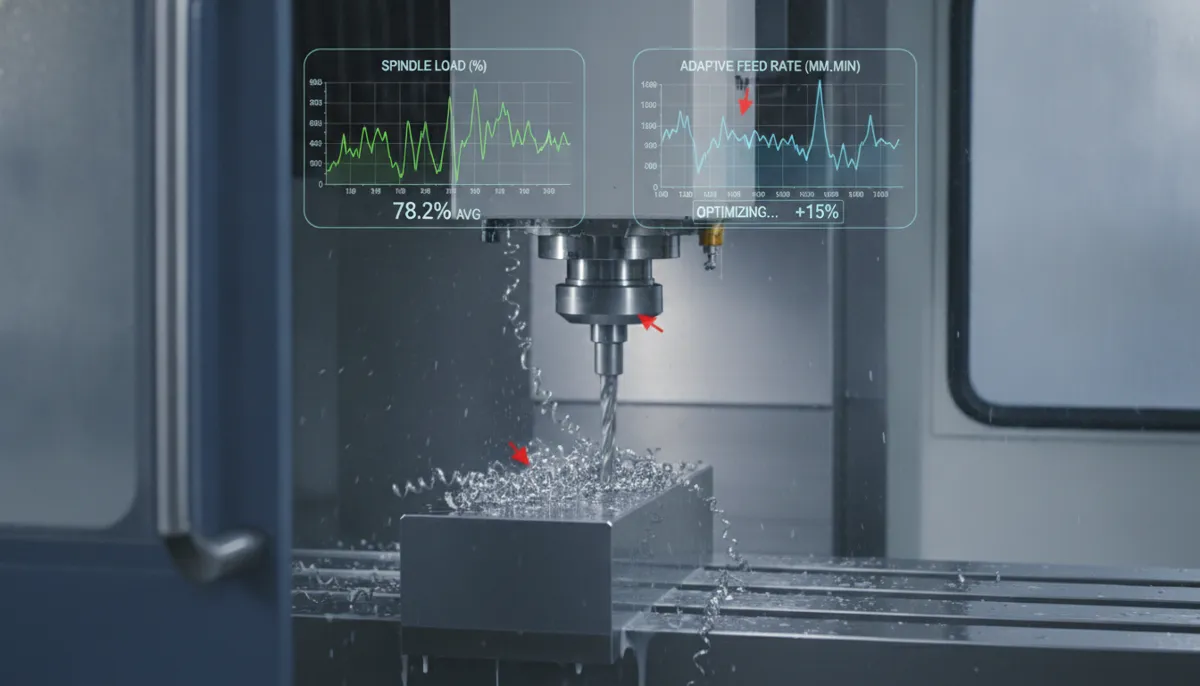
CNC coolant — the fluid applied to the cutting zone during machining — is one of the most important yet frequently overlooked variables in CNC operations. If you are new to CNC machining, understanding how coolant works, which type to choose, and how to deliver it correctly can mean the difference between a tool that lasts 30 minutes and one that lasts all shift. This beginner-friendly guide from QFCNCMachine explains the definition, core purposes, types, and real-world applications of CNC coolant, so you can make informed decisions from day one.
1. The Growing Importance of CNC Coolant in Modern Machining
The global metalworking fluids market — which encompasses all CNC coolants and cutting fluids — was valued at USD 11.9 billion in 2025 and is projected to grow to USD 15.9 billion by 2033, reflecting the rising demand for precision machining across aerospace, automotive, and medical sectors (Grand View Research, 2026). A separate analysis by MarketsandMarkets estimates the market at USD 6.93 billion in 2024, growing at a CAGR of 3.20% through 2030, driven by increasing adoption of water-miscible and synthetic coolants in high-speed CNC applications (MarketsandMarkets, 2024).
Peer-reviewed research published in PMC / NCBI confirms that proper coolant application in conventional and CNC machining processes directly improves surface quality, reduces thermal damage, and extends cutting tool life — with documented tool life improvements of 40–300% depending on material and coolant strategy (PMC/NCBI, 2021). A ScienceDirect review of coolant applications in tool-based machining further establishes that coolant selection and delivery method are among the most significant controllable variables affecting both tool wear rate and workpiece surface integrity (ScienceDirect, 2022).
2. What Is CNC Coolant? Definition and Core Purposes
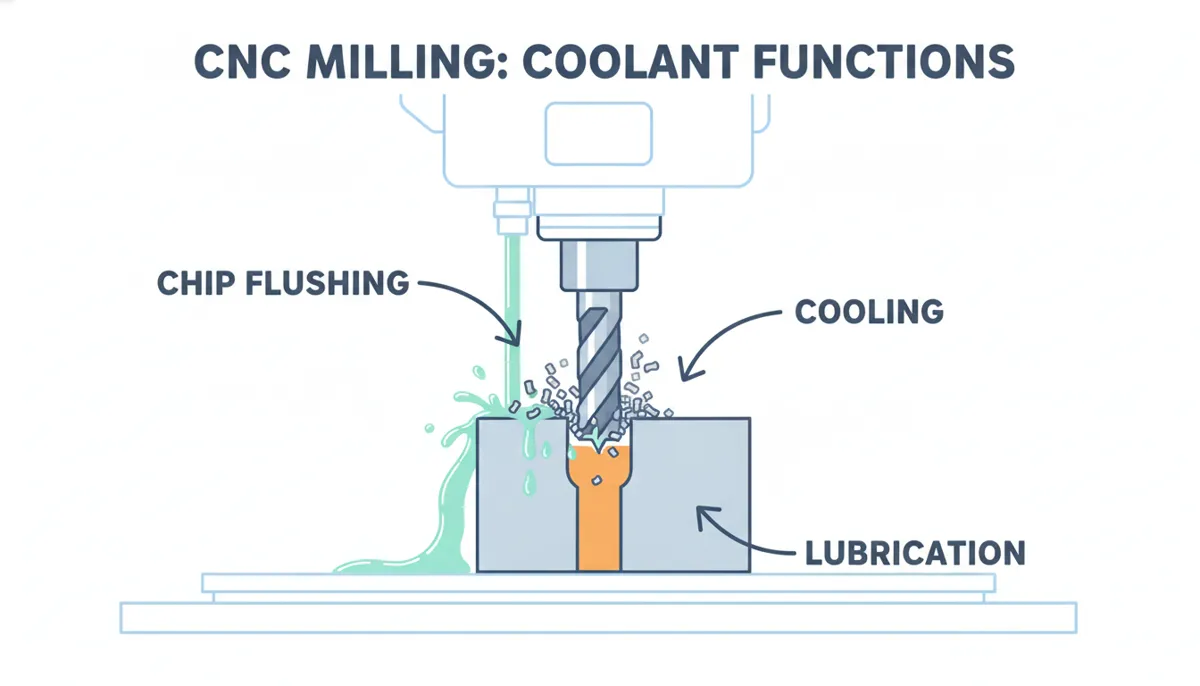
CNC coolant (also called cutting fluid) is a liquid applied to the cutting zone during milling, turning, drilling, or grinding operations. Its role goes far beyond simply keeping things cool — it performs four critical functions simultaneously:
- Cooling: Absorbs heat generated by friction and plastic deformation at the tool-chip interface, preventing thermal damage to both tool and workpiece.
- Lubrication: Reduces friction between the cutting edge and the chip, lowering cutting forces, reducing built-up edge (BUE), and improving surface finish.
- Chip evacuation: Flushes chips away from the cutting zone to prevent re-cutting, tool clogging, and surface scratching — especially critical in deep hole drilling and slotting.
- Corrosion protection: Most modern coolants contain anti-corrosion additives that protect both the machined workpiece and the machine tool’s internal components from rust and oxidation.
3. Types of CNC Coolant (Cutting Fluids)
Selecting the right CNC coolant type is as important as selecting the right cutting tool. The four main categories each offer distinct advantages depending on material, operation, and machine compatibility:
3.1 Water-Miscible Coolants (Emulsions)
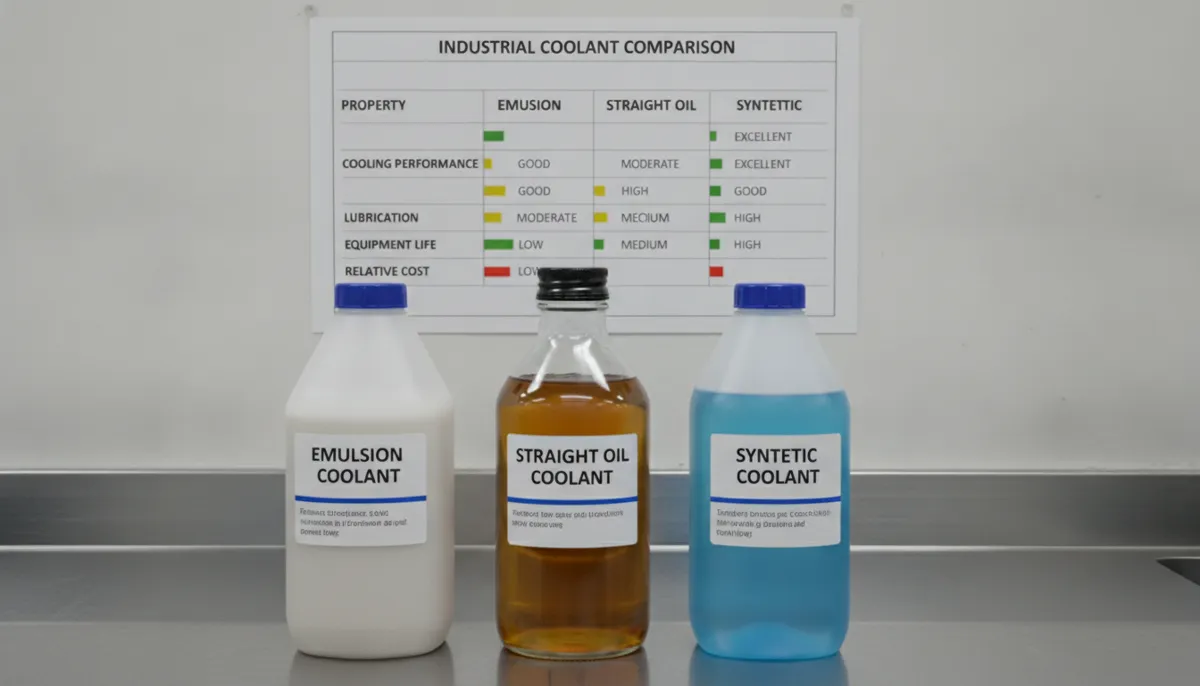
Water-miscible coolants are oil-in-water emulsions, typically mixed at 5–10% concentrate in water. They offer excellent heat dissipation due to water’s high specific heat capacity, are cost-effective, and are the most widely used coolant type in general CNC machining. Ideal for milling and turning of steel, aluminium, and plastics. The high water content makes them excellent coolants but moderate lubricants — best for operations where heat management is the primary concern.
3.2 Straight Oils (Neat Oils)
Straight oils are undiluted petroleum or vegetable-based oils applied directly without water mixing. They provide superior lubrication and are the preferred choice for demanding operations such as tapping, gear cutting, broaching, and deep hole drilling. Not suitable for high-speed operations due to lower cooling capacity. Best for tough, work-hardening materials like stainless steel, titanium, and Inconel where lubrication at the cutting edge is the priority.
3.3 Semi-Synthetic Coolants
Semi-synthetics combine mineral oil (typically 5–30%) with synthetic additives and water. They offer a balanced performance profile — better lubrication than pure synthetics and better cooling than straight oils. Widely used in production environments where a single coolant must handle multiple materials and operations. Good biological stability and operator safety profile.
3.4 Synthetic Coolants
Fully synthetic coolants contain no mineral oil — they are water-based solutions of chemical additives. They offer excellent cooling performance, superior cleanliness (no oily residue), and the longest sump life of any coolant type. Ideal for high-speed machining, grinding, and applications where a clean work environment is critical. However, they provide less lubrication than oil-based alternatives and may not be suitable for all metals.
4. CNC Coolant Types Comparison Table
Use the table below as a quick reference when selecting the right cutting fluid for your application:
| Coolant Type | Cooling Ability | Lubrication | Best For | Typical Mix Ratio | Sump Life |
|---|---|---|---|---|---|
| Water-Miscible (Emulsion) | Excellent | Moderate | General milling, turning (steel, aluminium) | 5–10% in water | 4–8 weeks |
| Straight Oil (Neat Oil) | Poor | Excellent | Tapping, deep drilling, gear cutting | Undiluted | 6–12 months |
| Semi-Synthetic | Good | Good | Multi-material production shops | 5–15% in water | 8–16 weeks |
| Synthetic | Very Good | Low–Moderate | High-speed machining, grinding | 3–10% in water | 16–26 weeks |
5. Core Features of an Effective CNC Coolant Delivery System
Choosing the right coolant type is only half the equation. A well-designed coolant delivery system ensures the fluid reaches the cutting zone at the right pressure, volume, and temperature. Here are the five key features to evaluate:
5.1 High-Pressure Delivery
Modern CNC coolant systems can deliver pressures from 70 psi (standard flood) up to 1,000 psi (high-pressure through-spindle). Higher pressure forces coolant directly into the cutting zone, breaking chips and providing superior cooling at the tool tip. For aluminium milling at 15,000 RPM, high-pressure coolant delivery at 300 psi can reduce cycle time by 12–18% compared to standard flood coolant by improving chip evacuation and allowing higher feed rates.
5.2 Through-Spindle Coolant (TSC)
Through-spindle coolant (TSC) delivers cutting fluid directly through internal channels in the tool, exiting at the cutting edge. This ensures the tip is constantly lubricated and cooled even in deep holes where external flood coolant cannot reach. TSC is essential for deep hole drilling (L/D > 5), reaming, and any operation where chip evacuation from the bore is critical. In deep hole drilling of 4140 steel, TSC at 300 psi can reduce drill breakage rates by 80–90% compared to external flood coolant alone.
5.3 Filtration and Recycling
Coolant must be continuously filtered to remove chips, fines, and tramp oil (leaked hydraulic or way oil). A good filtration system — paper band, magnetic drum, or centrifugal separator — extends coolant sump life, maintains consistent concentration, and prevents bacterial growth. Standard filtration at 50 microns is sufficient for most operations; high-precision grinding and finishing work benefits from 10–25 micron filtration to prevent surface scratching from fine particles.
5.4 Temperature Control
For tight-tolerance work (±0.005 mm or better), coolant temperature variation directly causes thermal expansion of the workpiece and machine structure, introducing dimensional errors. Coolant chillers maintain fluid at a set temperature (typically 20–25°C) to eliminate this variable. This is particularly critical for aerospace components, precision mould cavities, and medical implant manufacturing where dimensional consistency across long production runs is mandatory.
5.5 Ease of Maintenance
Coolant system downtime for maintenance reduces machine availability. Key design features that minimise maintenance time include: quick-change filter elements, easy-access coolant tanks with drain valves, automated concentration dosing systems, and coolant level sensors with low-level alarms. These features collectively reduce coolant-related maintenance time and ensure consistent coolant performance across shifts.
6. Real-World CNC Coolant Applications & Customer Results
6.1 High-Speed Aluminium Milling — Surface Finish Improvement (USA)
A US-based aerospace subcontractor was dry-cutting 6061-T6 aluminium brackets at 15,000 RPM, experiencing built-up edge (BUE) on their end mills and surface finish of 63 Ra — unacceptable for their anodising process. After switching to an 8% water-miscible emulsion with high-lubricity aluminium-specific additives, delivered at 150 psi flood, BUE was eliminated and surface finish improved to 32 Ra consistently. Tool life per edge extended from 45 minutes to over 90 minutes.
“We had been running dry on aluminium for years because we thought coolant wasn’t necessary for soft materials. The built-up edge was destroying our surface finish and our tools. After switching to the right emulsion coolant on our QFCNCMachine center, our Ra went from 63 to 32 in the first week, and we stopped replacing end mills every shift. It was the simplest fix with the biggest impact we’ve made in years.”
6.2 Deep Hole Drilling in Steel — Tool Breakage Elimination (Germany)
A German automotive parts manufacturer was drilling 20×D holes in 4140 steel for hydraulic manifold blocks. Without through-spindle coolant, drill breakage occurred approximately once every 50 holes, causing significant scrap and downtime. After implementing TSC at 300 psi with a semi-synthetic fluid on a QFCNCMachine vertical machining center, drill breakage dropped to fewer than 1 per 500 holes — a 10× improvement. Cycle time per part also reduced by 22% due to higher achievable feed rates with improved chip evacuation.
“Deep hole drilling was our biggest bottleneck — we were scrapping manifold blocks every day from drill breakage. The through-spindle coolant system on the QFCNCMachine center completely changed our process. We went from dreading that operation to running it lights-out on the night shift. The 2-year warranty and Bella’s team’s support during commissioning made the whole transition smooth.”
6.3 Titanium Turning for Medical Implants — Tool Life Tripled (Malaysia)
A Malaysian contract manufacturer producing Ti-6Al-4V orthopaedic implant components was experiencing rapid tool wear during turning operations — average tool life of just 18 minutes per edge due to titanium’s low thermal conductivity concentrating heat at the cutting zone. After switching to high-pressure straight oil coolant at 500 psi directed precisely at the tool-chip interface on a QFCNCMachine turning center, tool life increased to 55+ minutes per edge — a 200%+ improvement — and cycle time per implant reduced by 20%.
“Titanium was eating our inserts alive. We tried everything — different grades, different coatings — but the real problem was our coolant strategy. Switching to high-pressure straight oil targeted at the cutting edge on the QFCNCMachine turning center tripled our tool life overnight. Our cost per implant dropped significantly, and we now meet our medical client’s delivery schedule consistently. The machine’s rigidity at high coolant pressure made all the difference.”
7. Pros & Cons of Key CNC Coolant Strategies
✅ Flood Coolant — Pros
- Simple setup, low cost
- Excellent chip flushing for open operations
- Works well for general milling and turning
- Easy concentration monitoring and maintenance
- Compatible with most machine tool designs
❌ Flood Coolant — Cons
- Cannot reach deep holes or enclosed cutting zones
- Thermal shock risk on carbide at intermittent contact
- High fluid consumption and disposal cost
- Mist generation requires extraction system
- Ineffective above 500 psi without TSC upgrade
✅ Through-Spindle Coolant (TSC) — Pros
- Coolant delivered directly to cutting edge
- Essential for deep hole drilling (L/D > 5)
- Dramatically reduces drill breakage rates
- Enables higher feed rates and shorter cycle times
- Superior chip evacuation from bore
❌ Through-Spindle Coolant (TSC) — Cons
- Higher machine cost (spindle seals, rotary union)
- Requires clean, filtered coolant (clogs tool channels)
- Not all toolholders are TSC-compatible
- Higher pump and maintenance requirements
- Overkill for shallow, open milling operations
8. Frequently Asked Questions About CNC Coolant
What is the difference between CNC coolant and cutting fluid?
In practice, the terms are used interchangeably. Technically, “coolant” emphasises the heat-removal function, while “cutting fluid” emphasises the lubrication function. Both refer to the same category of fluids applied to the cutting zone during machining. Most modern formulations perform both functions simultaneously, so the distinction is largely semantic in day-to-day shop use.
Can I use plain water instead of CNC coolant?
No. Plain water lacks lubrication, contains no anti-corrosion additives, and will cause rust on both the workpiece and machine tool surfaces within hours. It also has no biocide protection, meaning bacterial growth begins almost immediately. Always use a proper coolant concentrate mixed with water at the manufacturer’s recommended ratio — typically 5–10% for water-miscible emulsions.
How often should I change CNC coolant?
Typically every 1–3 months for water-miscible emulsions, depending on usage intensity, contamination load, and filtration quality. Monitor pH weekly (target 8.5–9.5), check concentration with a refractometer (target 5–10%), and inspect for tramp oil and bacterial growth (indicated by foul smell or discolouration). Straight oils and synthetics have significantly longer sump lives — 6–12 months and 4–6 months respectively — with proper maintenance.
Is CNC coolant harmful to operators?
Modern industrial coolants are formulated with operator safety in mind, but prolonged skin contact can cause dermatitis in sensitive individuals. Best practices include: wearing nitrile gloves when handling concentrate, ensuring adequate machine enclosure and mist extraction, maintaining correct coolant concentration (over-concentration increases skin irritation risk), and replacing coolant on schedule to prevent bacterial growth. Always refer to the coolant manufacturer’s Safety Data Sheet (SDS) for specific handling guidance.
What CNC coolant is best for aluminium machining?
For aluminium, use a water-miscible emulsion with a high-lubricity additive specifically formulated for non-ferrous metals — often labelled “for aluminium” or “non-ferrous.” Avoid coolants with high chlorine or sulphur content, as these can cause surface staining and pitting on aluminium. A 6–8% emulsion concentration works well for most milling and turning operations. For high-speed finishing (Ra < 32 µin), consider a semi-synthetic with additional EP (extreme pressure) additives.
What is the correct coolant concentration?
Correct concentration depends on the coolant type and application, but for water-miscible emulsions the standard range is 5–10% (50–100 ml concentrate per litre of water). Use a refractometer to check concentration at least weekly — under-concentration reduces lubrication and corrosion protection, while over-concentration increases foam, skin irritation risk, and cost. Always mix concentrate into water (not water into concentrate) to ensure proper emulsification.
Need Help Choosing the Right CNC Coolant System?
Our engineering team — with 15+ years of CNC machining experience — can advise on coolant type, delivery pressure, and system configuration for your specific material and operation. 750+ customers across Europe, North America, and Southeast Asia trust QFCNCMachine for precision results since 2010. All machines come with a 2-year warranty and full after-sales support.
References
- Grand View Research. Metalworking Fluids Market Size & Share Report, 2026–2033. Retrieved August 2026 from https://www.grandviewresearch.com/industry-analysis/metalworking-fluids-market
- MarketsandMarkets. Metalworking Fluids Market Report 2025–2030. Retrieved August 2026 from https://www.marketsandmarkets.com/Market-Reports/metal-working-fluid-market-116835111.html
- PMC / National Center for Biotechnology Information (NCBI). Recent Progress and Evolution of Coolant Usages in Conventional Machining Processes, 2021. Retrieved August 2026 from https://pmc.ncbi.nlm.nih.gov/articles/PMC8542508/
- ScienceDirect. Application of Coolants During Tool-Based Machining — A Review, Ain Shams Engineering Journal, 2022. Retrieved August 2026 from https://www.sciencedirect.com/science/article/pii/S2090447922001411