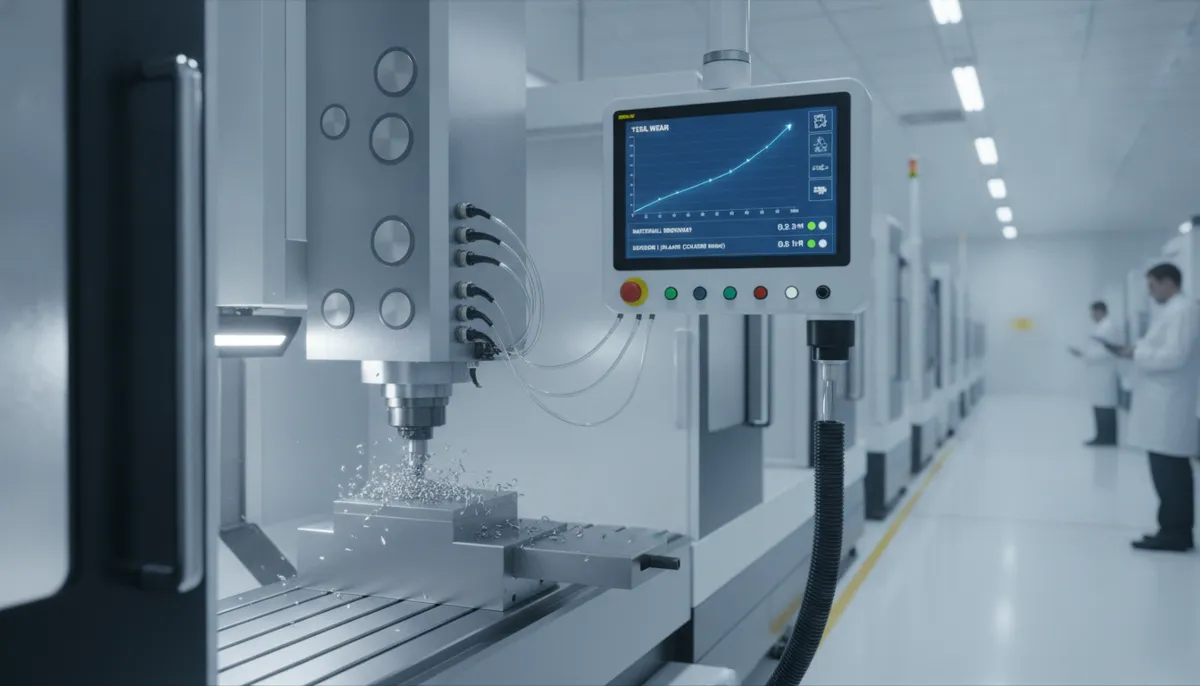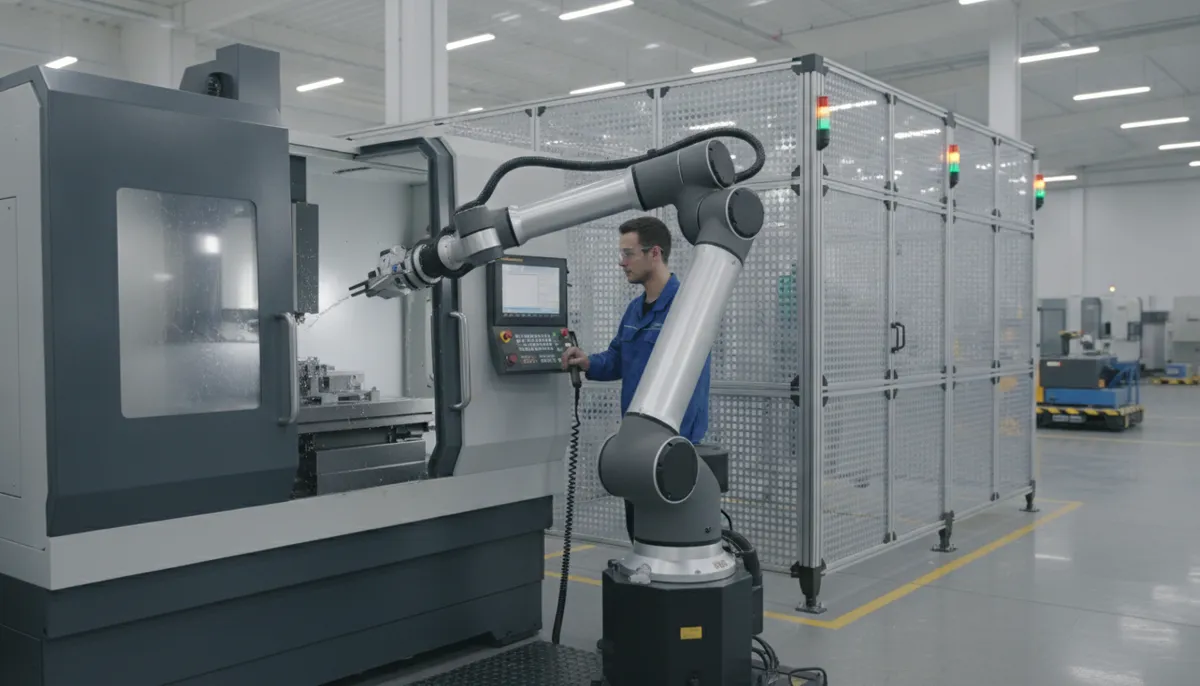
CNC human robot collaboration is reshaping how modern machine shops operate — enabling cobots and skilled operators to share the same workspace safely, without traditional safety cages, while delivering higher throughput and lower operator fatigue. At QFCNCMACHINE.COM, we have been engineering and exporting precision CNC machining centers since 2010, supporting 750+ clients across Europe, North America, and Southeast Asia from our factory in Dalingshan, Dongguan, Guangdong, China. In this guide, we break down how CNC human robot collaboration works in practice, what safety standards govern it, and how to evaluate whether cobot integration is the right next step for your production environment.
1. The Market Case for CNC Human Robot Collaboration
The collaborative robot (cobot) market is one of the fastest-growing segments in industrial automation. According to Persistence Market Research, the global cobot market is projected to grow from USD 3.4 billion in 2026 to USD 12.6 billion by 2033, driven by rising demand for flexible, human-safe automation in high-mix manufacturing environments — exactly the conditions found in most CNC machine shops. The same report highlights Asia-Pacific and Europe as the two leading adoption regions, reflecting the markets QFCNCMACHINE primarily serves (Persistence Market Research, Collaborative Robot Market Forecast to 2033).
At the macro level, the International Federation of Robotics (IFR) World Robotics 2025 Report confirmed that global industrial robot installations reached 542,000 units in 2024 — more than double the figure recorded a decade ago — with annual installations exceeding 500,000 units for the fourth consecutive year. Collaborative robots represent a growing share of this installed base, particularly in applications requiring direct human-machine interaction such as CNC machine tending, deburring, and assembly (IFR, World Robotics 2025 Report).
For CNC machining centers specifically, Mordor Intelligence reports that the global machining centers market continues to expand steadily, with automation integration — including cobot-assisted machine tending — identified as a primary growth driver as manufacturers seek to offset rising labor costs and address skilled operator shortages (Mordor Intelligence, Machining Centers Market Size, Share & Growth Trends Report, 2024).
2. Core Features That Make CNC Human Robot Collaboration Work
2.1 Force-Limiting Safety Architecture
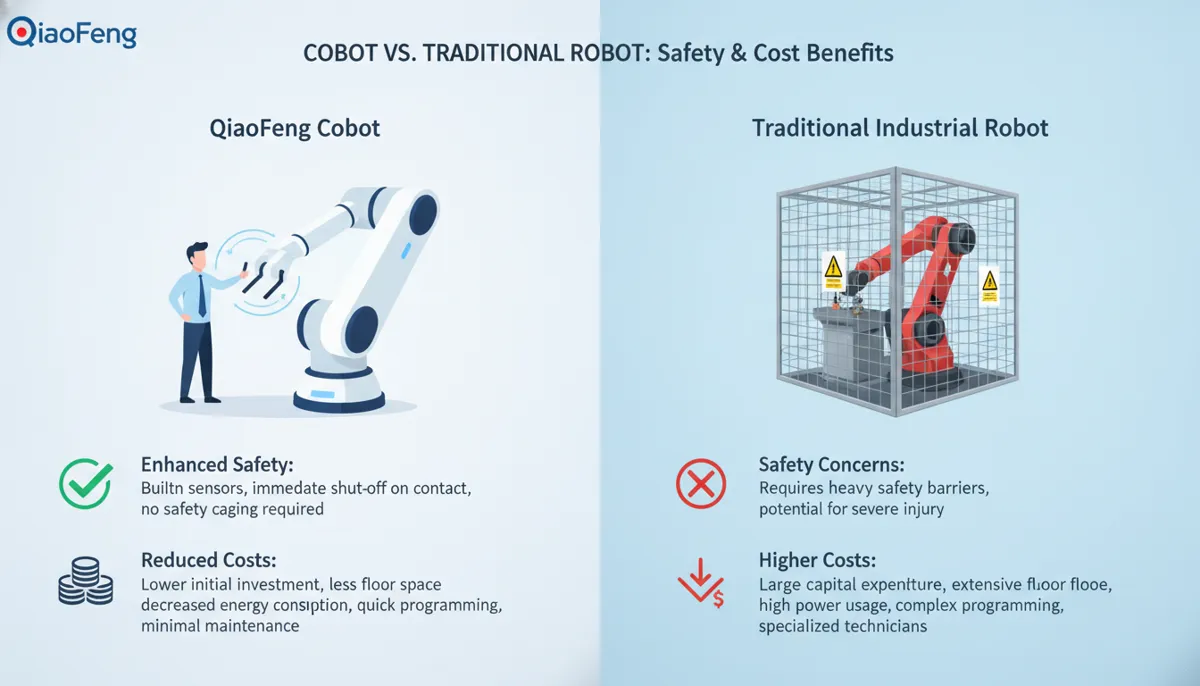
The foundational technology enabling CNC human robot collaboration is force-limiting — the ability of a cobot to detect unexpected contact and stop within milliseconds, preventing injury without requiring physical barriers. This capability is governed by two international standards: ISO 10218, which sets safety requirements for industrial robot design and system integration, and ISO/TS 15066, which defines the specific force and pressure limits permitted during human-robot contact in collaborative operations. Together, these standards provide the engineering framework that allows cobots to operate safely alongside CNC operators in shared workspaces (AMD Machines, ISO 10218 & ISO/TS 15066: Robot Safety Guide). For machine shops, compliance with these standards is the prerequisite for removing safety cages and enabling true side-by-side operation.
2.2 Intuitive Teach-and-Repeat Programming
One of the most significant practical barriers to cobot adoption in CNC environments has historically been programming complexity. Modern cobots designed for CNC human robot collaboration address this with touchscreen-based teach pendants and graphical drag-and-drop interfaces that allow operators to define new tasks through physical demonstration rather than code. This dramatically reduces the skill threshold for deployment and allows shops to reassign cobots to new tasks as production schedules change — a critical capability for high-mix, low-volume operations where flexibility is as important as throughput.
2.3 Payload Range and Repeatability for CNC Tasks
For practical CNC machine tending, cobots typically need to handle workpieces in the 2 kg to 20 kg range with repeatability in the ±0.02 mm to ±0.05 mm range — sufficient for loading and unloading most turned and milled components, as well as downstream tasks like deburring and basic assembly. Selecting the right payload and reach configuration for your specific part family is one of the first engineering decisions in any CNC human robot collaboration integration project, and it directly affects the ROI calculation.
3. CNC Human Robot Collaboration vs. Traditional Industrial Robot Automation
| Feature | Cobot (Human-Robot Collaboration) | Traditional Industrial Robot |
|---|---|---|
| Safety Architecture | Force-limited, stops on contact (ISO 10218 / ISO/TS 15066) | Requires safety cages, light curtains, interlocked fencing |
| Shared Workspace | Yes — operator and cobot can work side by side | No — humans must stay outside the safety perimeter during operation |
| Deployment Time | 1–2 days for single machine integration | 1–3 weeks including safety infrastructure installation |
| Programming | Teach-and-repeat, graphical interface, no coding required | Proprietary code, specialist programmer typically required |
| Payload Range | Typically 3 kg – 20 kg | Up to 200+ kg — often oversized for CNC tending tasks |
| Floor Space Impact | Compact — can mount on existing machine base or pedestal | Requires dedicated cell with safety perimeter clearance |
| Flexibility for High-Mix | High — quick retasking between part families | Low — reprogramming and safety re-validation required |
| Best Application Fit | CNC tending, deburring, inspection, assembly — human interaction required | High-speed, heavy-load, fully automated cells — no human interaction |
4. Real-World Applications of CNC Human Robot Collaboration
4.1 Machine Tending in High-Mix CNC Production
High-mix, low-volume job shops face a persistent tension between the need for automation and the need for flexibility. Traditional industrial robots are difficult to justify economically when part families change frequently and batch sizes are small. CNC human robot collaboration resolves this tension: a cobot mounted on a mobile pedestal can be repositioned between CNC lathes and machining centers as the production schedule demands, with operators reprogramming new tasks through the teach pendant in minutes rather than hours. The cobot handles the repetitive loading and unloading cycle — the primary source of operator musculoskeletal strain in machine tending — while the operator focuses on setup, quality verification, and process oversight.
4.2 Deburring and Surface Finishing
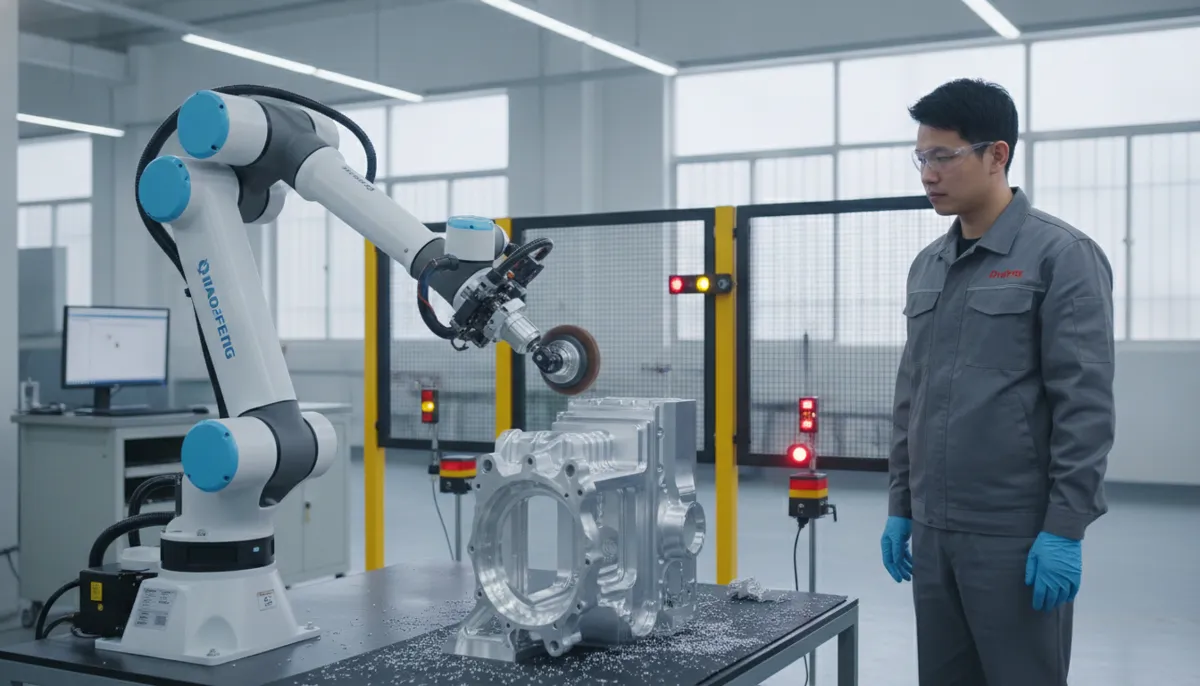
Deburring is one of the most ergonomically damaging tasks in a CNC machine shop — repetitive, force-intensive, and difficult to standardize manually. A cobot equipped with a force-controlled spindle tool and a vision system can perform consistent deburring on complex geometries with repeatable contact force, eliminating the variability that leads to rework and the physical strain that leads to operator injury. In CNC human robot collaboration deburring cells, the operator loads raw castings or machined parts while the cobot performs the deburring cycle — a genuine side-by-side workflow that leverages the strengths of both human judgment and robotic consistency.
4.3 Quality Inspection Assistance and Assembly
In medical device and precision aerospace manufacturing, where every part requires documented inspection, cobots can assist by holding parts in precise orientations for measurement, performing vision-based dimensional checks, or executing repeatable screwdriving and press-fit assembly operations. The human operator retains responsibility for final judgment and sign-off, while the cobot handles the physically demanding and repetitive positioning tasks. This division of labor is the practical definition of effective CNC human robot collaboration — not replacing the operator, but amplifying their capability and protecting their physical wellbeing.
5. What Our Clients Say About CNC Human Robot Collaboration
“We integrated a cobot for machine tending on three of our CNC lathes producing automotive brake components. The transition was smoother than we expected — our operators were running the cobot confidently within two days of installation. The biggest surprise was how much the operators themselves appreciated it: the repetitive loading cycle that was causing wrist strain is now handled by the cobot, and our team focuses on setup and quality. Our throughput on those machines has improved meaningfully, and we haven’t had a single safety incident in over a year of operation.”
“We were skeptical about removing the safety cage — it felt counterintuitive. But after reviewing the ISO 10218 and ISO/TS 15066 compliance documentation and running a risk assessment with QFCNCMACHINE’s support team, we were confident the force-limiting architecture was genuinely safe. Eighteen months later, our cobot is running two shifts alongside our operators on aerospace bracket deburring, and the consistency of the surface finish has eliminated the rework loop that was costing us significant time every week.”
“เราใช้ระบบ CNC human robot collaboration สำหรับงาน machine tending ในไลน์ผลิตชิ้นส่วนอิเล็กทรอนิกส์ทางการแพทย์ ก่อนหน้านี้พนักงานต้องยืนรอหน้าเครื่องตลอดเวลา ทำให้เกิดความเมื่อยล้าสะสม หลังจากติดตั้ง cobot พนักงานสามารถดูแลเครื่องได้หลายเครื่องพร้อมกัน และคุณภาพชิ้นงานมีความสม่ำเสมอมากขึ้นอย่างเห็นได้ชัด ทีมสนับสนุนของ QFCNCMACHINE ช่วยเราตลอดกระบวนการติดตั้งและให้การรับประกัน 2 ปีที่ทำให้เรามั่นใจในการลงทุนครั้งนี้”
6. Pros & Cons of CNC Human Robot Collaboration
✅ Advantages
- Genuine shared workspace: ISO 10218 / ISO/TS 15066 compliant force-limiting allows cage-free side-by-side operation
- Reduced operator fatigue: Cobots absorb repetitive, physically demanding tasks — loading cycles, deburring, part holding
- Fast deployment: Typical single-machine integration in 1–2 days; operators productive within hours
- High flexibility: Quickly retasked between part families — well-suited to high-mix, low-volume CNC environments
- Lower entry cost vs. traditional automation: No safety cage infrastructure required; compact footprint fits existing layouts
- Scalable supervision: One operator can manage multiple cobot-tended machines simultaneously
❌ Considerations
- Payload ceiling: Most cobots top out at 20 kg — not suitable for heavy workpieces requiring traditional industrial robots
- Speed trade-off: Force-limiting safety architecture requires reduced operating speeds in shared zones — lower cycle throughput than caged high-speed robots
- Risk assessment required: Even with ISO-compliant cobots, a formal collaborative workspace risk assessment is mandatory before removing safety barriers
- Initial programming investment: Despite intuitive interfaces, complex multi-step tasks still require careful teach-and-verify cycles
- Not a fit for all tasks: High-speed, heavy-load, fully automated cells are still better served by traditional industrial robots
7. Frequently Asked Questions About CNC Human Robot Collaboration
Is it genuinely safe for a cobot to work next to a human operator without a safety cage?
Yes — when the system is correctly designed and a proper risk assessment has been completed. CNC human robot collaboration safety is governed by ISO 10218 (robot design and integration requirements) and ISO/TS 15066 (contact force and pressure limits for collaborative operations). These standards define the engineering requirements — including force-limiting, speed monitoring, and emergency stop — that must be met before safety barriers can be removed. Compliance with both standards is the prerequisite, not an optional enhancement. Any cobot integration project should include a documented collaborative workspace risk assessment before cage removal.
How long does it take to integrate a cobot with an existing CNC machine?
For a single CNC lathe or machining center, a straightforward machine tending integration typically takes one to two days, including mechanical mounting, gripper setup, communication configuration (Ethernet/IP, Profinet, or Modbus TCP are the most common protocols), and initial task programming. More complex applications involving vision systems, multiple part variants, or custom end-of-arm tooling will require additional time. Remote support and on-site commissioning assistance are available through QFCNCMACHINE for clients requiring technical guidance during integration.
What payload range is appropriate for CNC machine tending?
The majority of CNC turned and milled components handled in machine tending applications fall within the 1 kg to 15 kg range, which is well within the capability of most cobots in the 10 kg to 20 kg payload class. For heavier workpieces, a traditional industrial robot is typically the more appropriate solution. Selecting the correct payload class also affects reach, repeatability, and operating speed — all of which should be evaluated against your specific part family before specifying a cobot for CNC human robot collaboration.
What ROI can realistically be expected from cobot integration?
ROI from CNC human robot collaboration comes from several compounding sources: reduced direct labor cost per part (one operator managing multiple machines), elimination of overtime on repetitive tending tasks, reduced scrap from consistent loading and unloading cycles, and lower long-term costs from reduced operator musculoskeletal injury and associated absenteeism. Payback timelines vary significantly based on labor rates, shift patterns, part complexity, and current scrap rates. We provide a detailed, application-specific ROI analysis as part of our free consultation process — contact us before making any investment decision.
What warranty and after-sales support does QFCNCMACHINE provide?
All CNC machines supplied by QFCNCMACHINE come with a 2-year warranty covering manufacturing defects and component failures under normal operating conditions. For confirmed quality issues, we fully support returns and refunds in accordance with our quality guarantee policy. Warranty does not cover consumable items or damage resulting from misuse. Our after-sales team provides remote diagnostics, spare parts dispatch, and on-site support where required. Contact us for complete warranty terms.
Ready to Bring CNC Human Robot Collaboration to Your Shop Floor?
Talk to Bella and our engineering team — 15 years in CNC manufacturing, 750+ global clients across Europe, North America, and Southeast Asia. Factory direct from Dalingshan, Dongguan, China since 2010. Get a free application assessment and find out whether cobot integration is the right fit for your production environment.
References
- International Federation of Robotics (IFR). World Robotics 2025 Report — Industrial Robots. (2025). https://ifr.org/ifr-press-releases/news/global-robot-demand-in-factories-doubles-over-10-years
- Persistence Market Research. Collaborative Robot (Cobot) Market — Global Industry Analysis and Forecast to 2033. (2025). https://www.persistencemarketresearch.com/market-research/collaborative-robot-market.asp
- Mordor Intelligence. Machining Centers Market Size, Share & Growth Trends Report, 2024. https://www.mordorintelligence.com/industry-reports/machining-centers-market
- AMD Machines. ISO 10218 & ISO/TS 15066: Robot Safety Standards Guide. https://amdmachines.com/blog/robot-safety-standards-iso-10218-and-ts-15066-explained/
- Future Market Insights. Collaborative Robots Market — Global Analysis Report, 2025–2035. https://www.futuremarketinsights.com/reports/collaborative-robot-market