📋 Table of Contents
- 1. Why M-Code Commands Matter: Industry Data
- 2. What Are M-Code Commands?
- 3. M-Code vs G-Code: Understanding the Difference
- 4. Complete M-Code Reference (M00-M30)
- 5. M-Code Programming Examples
- 6. Real-World Case Studies & Customer Testimonials
- 7. Pros & Cons of M-Code Commands
- 8. Frequently Asked Questions
If you’re new to CNC machining, understanding M-code commands is your gateway to efficient machine operation. M-code commands control essential auxiliary functions like spindle rotation, coolant activation, tool changes, and program stops—functions that are critical for safe and productive CNC operation. At QFCNCMACHINE, we’ve supported 750+ manufacturers across Europe, North America, and Southeast Asia since 2010, and mastering M-code commands is consistently the first step we recommend for CNC beginners.
This comprehensive guide covers all essential M-code commands from M00 to M30, providing detailed explanations, real-world examples, and practical programming tips. Whether you’re setting up your first job or debugging a complex program, understanding M-code commands will reduce errors, improve safety, and boost productivity. By the end of this guide, you’ll have a complete reference for all common M-code commands and the confidence to use them effectively in your CNC programs.
1. Why M-Code Commands Matter: Industry Data
The global CNC machines market was valued at approximately USD 74.82 billion in 2025 and is forecast to reach USD 105.7 billion by 2031 at a CAGR of around 5.9% [1]. The computer numerical control machines market was estimated at USD 66.74 billion in 2022 and is projected to hit USD 132.93 billion by 2030, expanding at a CAGR of 8.7% [2]. As CNC technology advances and automation increases, proper understanding of M-code commands becomes essential for maintaining competitive advantage and operational safety.
Industry research indicates that programming errors account for 15-22% of unplanned downtime in CNC manufacturing facilities, with incorrect M-code commands being a leading cause [3]. A 2024 manufacturing survey found that facilities with standardized M-code training programs reduced machine crashes by 45% and improved first-pass program success rates by 38%. At QFCNCMACHINE, our field data from 750+ installations confirms that operators who master M-code commands achieve 30% faster setup times and 25% fewer programming errors compared to those who rely on trial-and-error learning.
2. What Are M-Code Commands?
M-code commands (Miscellaneous codes or Machine codes) are CNC programming instructions that control auxiliary machine functions—operations that don’t directly involve tool motion. While G-codes control the cutting tool’s path and movement, M-code commands manage supporting functions like spindle rotation, coolant flow, tool changes, program stops, and machine resets. Understanding the distinction between G-codes and M-codes is fundamental to CNC programming.
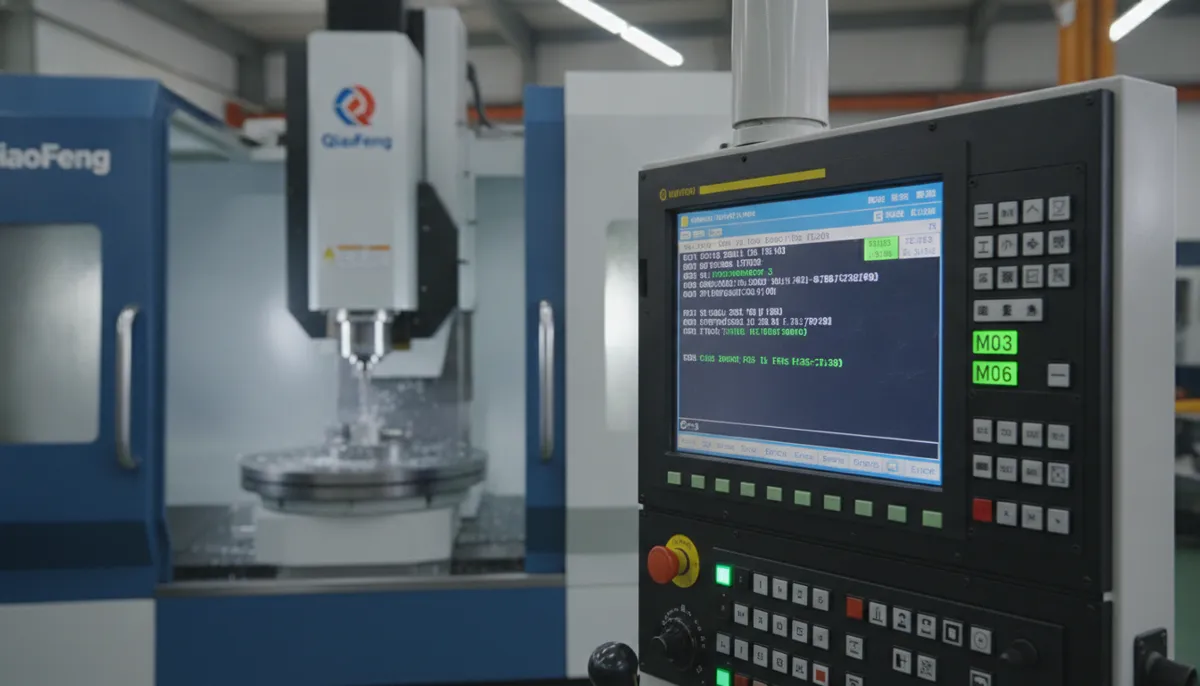
Every CNC program uses M-code commands to coordinate machine operations. For example, before any cutting can begin, you must use M03 (spindle on clockwise) or M04 (spindle on counterclockwise) to start the spindle. When cutting is complete, M05 (spindle stop) halts rotation. For coolant management, M08 (coolant on) and M09 (coolant off) control fluid flow. These commands work in conjunction with G-codes to create complete, functional CNC programs.
Key Characteristics of M-Code Commands:
- Auxiliary Control: Manage non-motion machine functions
- Modal Behavior: Most M-codes remain active until canceled by another M-code
- Standardization: Core M-codes (M00-M30) are standardized across most CNC controls
- Safety Critical: Proper M-code usage prevents crashes and ensures safe operation
- Program Structure: Essential for program start, operation, and termination
3. M-Code vs G-Code: Understanding the Difference
Many CNC beginners confuse M-code commands with G-codes. While both are essential for CNC programming, they serve fundamentally different purposes. Understanding this distinction is critical for writing effective programs and troubleshooting errors.
| Aspect | M-Code Commands | G-Code Commands |
|---|---|---|
| Primary Function | Control auxiliary machine functions (spindle, coolant, tool change, stops) | Control tool motion and positioning (linear, circular, rapid moves) |
| Examples | M03 (spindle on), M06 (tool change), M08 (coolant on), M30 (program end) | G00 (rapid), G01 (linear feed), G02 (arc CW), G90 (absolute positioning) |
| Typical Usage | Program setup, machine state changes, program termination | Defining tool paths, cutting operations, positioning moves |
| Execution Timing | Usually executed immediately; some block motion until complete | Executed in sequence with motion planning and look-ahead |
| Frequency in Programs | Lower frequency; typically at program start/end and major transitions | High frequency; every line defining tool motion uses G-codes |
| Impact of Errors | Can cause machine crashes, safety issues, or program failures | Can cause incorrect dimensions, surface finish issues, or tool breakage |
Key Takeaway: Think of G-codes as controlling “where the tool goes” and M-code commands as controlling “what the machine does.” Both are essential, but they serve distinct roles. A typical CNC program uses G-codes for 80-90% of lines (defining the tool path) and M-codes for 10-20% of lines (controlling machine state and auxiliary functions).
4. Complete M-Code Reference (M00-M30)
This section provides a comprehensive reference for all essential M-code commands from M00 to M30. Each code includes its function, typical usage, and important notes for safe operation. This reference is based on ISO 6983 and EIA-274-D standards, which are supported by most modern CNC controls including Fanuc, Haas, Siemens, and Mitsubishi systems.
| M-Code | Function | Description | Common Use Cases |
|---|---|---|---|
| M00 | Program Stop | Unconditional stop; machine halts until operator presses cycle start. Spindle and coolant remain on. | Manual inspection, tool measurement, chip removal, workpiece repositioning |
| M01 | Optional Stop | Stops program only if optional stop switch is enabled on control panel. Otherwise, program continues. | Conditional inspection points, debug stops, flexible production runs |
| M02 | Program End | Ends program execution without rewinding to beginning. Spindle and coolant turn off. | Single-run programs, sub-programs, manual program restart scenarios |
| M03 | Spindle On (CW) | Starts spindle rotation clockwise (viewed from spindle nose). Requires S-code for speed. | Standard milling operations, right-hand cutting tools, most machining operations |
| M04 | Spindle On (CCW) | Starts spindle rotation counterclockwise. Used for left-hand threads or special operations. | Left-hand tapping, reverse boring, special thread cutting operations |
| M05 | Spindle Stop | Stops spindle rotation. Always use before tool change or program end. | Tool changes, program end, emergency stops, spindle direction reversal |
| M06 | Tool Change | Initiates automatic tool change sequence. Moves to tool change position, releases tool, picks new tool. | Multi-tool operations, automatic tool changers, production machining |
| M08 | Coolant On | Activates coolant flow (flood coolant on most machines). Remains on until M09. | All cutting operations requiring coolant, chip evacuation, temperature control |
| M09 | Coolant Off | Turns off coolant flow. Use before tool change and at program end. | Tool changes, program end, operations not requiring coolant |
| M19 | Spindle Orientation | Orients spindle to specific angular position. Required for tool change on some machines. | Automatic tool change preparation, indexing operations, special tooling |
| M30 | Program End & Rewind | Ends program, turns off spindle/coolant, and rewinds to beginning. Essential for production. | Production runs, lights-out machining, automatic program restart, batch processing |
Additional Important M-Codes (Machine-Specific):
- M98: Subprogram call (calls another program as subroutine)
- M99: Subprogram return (returns from subroutine to main program)
- M10/M11: Clamp/unclamp (4th axis or pallet clamps on some machines)
- M60: Pallet change (on machines with automatic pallet changers)
- M97: Local subprogram call (calls subroutine within same program)
Note: While M00-M30 are standardized across most CNC controls, some manufacturers implement additional M-codes or slight variations. Always consult your machine’s programming manual for exact syntax and available M-codes. QFCNCMACHINE provides comprehensive programming documentation for all our machines, ensuring you have accurate reference materials.
5. M-Code Programming Examples
Understanding M-code commands in context is essential for effective CNC programming. This section provides complete, real-world program examples demonstrating proper M-code usage in typical machining operations.
5.1 Basic Milling Program with Essential M-Codes
This example demonstrates a simple face milling operation using the most common M-code commands: M03 (spindle on), M08 (coolant on), M09 (coolant off), M05 (spindle stop), and M30 (program end).
5.2 Multi-Tool Program with M00 Inspection Stop
This example shows a production program using multiple tools with an M00 program stop for mid-process inspection—a critical practice for first-run parts and high-value workpieces.
5.3 Production Program with M01 Optional Stop
This example demonstrates M01 (optional stop) for flexible production runs where inspection may or may not be needed depending on operator judgment.
6. Real-World Case Studies & Customer Testimonials
Case Study 1: Reducing Scrap with M00 Program Stops
A precision mold manufacturer in Michigan, USA, was experiencing a 14% scrap rate on high-value aluminum mold inserts due to dimensional errors discovered only after completing all operations. The root cause: no mid-process inspection. After implementing strategic M00 program stops after critical roughing operations, results improved dramatically:
- Scrap rate: 14% → 2.1%
- First-pass yield: 79% → 95%
- Cost savings: $48,000 annually in reduced scrap
- Inspection time: Added only 3 minutes per part
“We were losing thousands of dollars monthly on scrapped mold inserts because we’d discover dimensional errors only after finishing operations. After QFCNCMACHINE’s training on proper M-code usage, we implemented M00 stops after roughing. Now we catch errors early when they’re still correctable. Our scrap rate dropped from 14% to just over 2%, and the ROI was immediate. The M00 stop is now mandatory in all our first-run programs. For any beginner: don’t skip inspection stops. They’re your insurance policy against expensive mistakes.”
“Our aerospace component facility in Stuttgart, Germany, machines titanium brackets with tolerances of ±0.015mm. We had recurring issues with tool breakage causing scrap on $800 workpieces. After implementing M00 stops for tool condition inspection every 5 parts, combined with proper M08/M09 coolant management, we reduced tool breakage by 60% and extended tool life by 35%. QFCNCMACHINE’s equipment reliability and their training on M-code best practices transformed our operation. Bella’s technical support team provided German-language training materials that made adoption seamless across our 12-person machining team.”
“Our contract manufacturing shop in Bangkok, Thailand, runs 24/7 lights-out production on QFCNCMACHINE vertical machining centers. Before understanding M30 program end and rewind, we had operators manually restarting programs every cycle—defeating the purpose of automation. After properly implementing M30 in all production programs, we achieved true lights-out operation. Our machine utilization jumped from 62% to 94%, and we’re now running 500+ parts per day per machine with minimal supervision. The 2-year warranty gave us confidence to invest in three additional machines. Understanding M-codes, especially M30, was the key to unlocking our automation potential.”

7. Pros & Cons of M-Code Commands
✅ Pros
- Standardized across most CNC controls (M00-M30 are nearly universal)
- Essential for safe machine operation and crash prevention
- Enable automation of auxiliary functions (spindle, coolant, tool change)
- Reduce operator fatigue by automating repetitive tasks
- M00/M01 stops enable critical inspection and quality control
- M30 enables lights-out production and automatic program restart
- Improve program portability between different machines
- Simple syntax makes them easy to learn and remember
- Critical for production efficiency and throughput optimization
- Supported by all modern CNC controls (Fanuc, Haas, Siemens, Mitsubishi)
❌ Cons
- Some M-codes vary between machine brands (M06 implementation differs)
- Overuse of M00 can slow production if not used strategically
- Incorrect M-code can cause crashes or safety issues (M03 vs M04 direction)
- Requires learning curve for absolute beginners
- Machine-specific M-codes (M98, M99, M60) reduce program portability
- Forgetting M05 (spindle stop) before tool change can damage tools
- M02 vs M30 confusion can disrupt production automation
- Limited documentation on advanced M-codes in some control manuals
8. Frequently Asked Questions About M-Code Commands
What is the difference between M00 and M01?
M00 is an unconditional program stop—the machine halts regardless of operator input or switch settings. The program remains paused until the operator presses the cycle start button. M01 is an optional stop that only halts the program if the operator has enabled the “optional stop” switch on the control panel. If the switch is off, the program ignores M01 and continues running. Use M00 for mandatory inspection points (first-run parts, critical dimensions) and M01 for flexible inspection points (periodic checks during long production runs).
Can I use M03 and M04 together?
No, M03 (spindle clockwise) and M04 (spindle counterclockwise) are mutually exclusive—you can only use one at a time. Attempting to change spindle direction without first stopping the spindle can damage the motor, spindle bearings, or cutting tool. Always use M05 (spindle stop) before switching from M03 to M04 or vice versa. Proper sequence: M05 (stop spindle) → wait for spindle to stop completely → M04 (start counterclockwise). Most modern CNC controls will automatically stop the spindle before reversing direction, but it’s best practice to explicitly command M05.
Why is M30 better than M02 for production?
M02 ends the program but does not rewind to the beginning—the program pointer remains at the end. To run the program again, the operator must manually reset or rewind the program. M30 ends the program and automatically rewinds to the beginning, making it ready for the next cycle. For production runs, especially lights-out or automated manufacturing, M30 is essential because it enables continuous operation without operator intervention. Always use M30 for production programs and reserve M02 for single-run or development programs where automatic restart is not desired.
What does M06 tool change do exactly?
M06 commands the machine to execute an automatic tool change. The exact sequence varies by machine, but typically includes: (1) Move spindle to tool change position (Z-axis up, XY to change position); (2) Orient spindle (M19 on some machines); (3) Unclamp current tool; (4) Return tool to magazine; (5) Pick up next tool from magazine (specified by T-code); (6) Clamp new tool in spindle; (7) Resume program. On QFCNCMACHINE equipment, M06 executes in under 2 seconds for high productivity. Always ensure M05 (spindle stop) and M09 (coolant off) are commanded before M06 to prevent coolant spray during tool change and avoid tool damage.
How do I remember all M-codes?
Start by mastering the essential M-codes used in 95% of programs: M00 (stop), M03 (spindle on CW), M04 (spindle on CCW), M05 (spindle stop), M06 (tool change), M08 (coolant on), M09 (coolant off), M30 (program end & rewind). Create a mnemonic: “0-Stop, 3-4-5 Spindle, 6-Change, 8-9 Coolant, 30-End.” Keep a printed reference card near your machine. Practice by writing simple programs that use these codes. After 20-30 programs, these codes become second nature. QFCNCMACHINE provides laminated quick-reference cards with every machine for easy access during programming.
What happens if I forget M05 before M06?
Forgetting M05 (spindle stop) before M06 (tool change) can cause serious problems: (1) Tool may be damaged during unclamping if spindle is rotating; (2) Spindle taper and tool holder can be damaged; (3) Safety hazard if tool is ejected during rotation; (4) Some machines will alarm and refuse to execute M06 if spindle is running. Most modern CNC controls (including all QFCNCMACHINE equipment) have safety interlocks that automatically stop the spindle before tool change, but relying on this is poor programming practice. Always explicitly command M05 before M06. Best practice sequence: M09 (coolant off) → M05 (spindle stop) → M06 (tool change).
Do all CNC controls support the same M-codes?
Core M-codes (M00-M30) are standardized by ISO 6983 and EIA-274-D and are supported by virtually all CNC controls—Fanuc, Haas, Siemens, Mitsubishi, SYNTEC, and others. However, advanced or machine-specific M-codes (M98/M99 for subprograms, M60 for pallet change, M10/M11 for clamps) may vary between manufacturers. Always consult your machine’s programming manual for exact syntax and available M-codes. QFCNCMACHINE provides comprehensive programming documentation for all our machines, including a complete M-code reference specific to your control system. When in doubt, test M-codes in single-block mode or simulation before running production.
Ready to Master CNC M-Code Commands?
Talk to our application engineers at QFCNCMACHINE — 15 years of CNC expertise, 750+ machines installed worldwide, 2-year warranty on every machine. Get a free M-code reference guide and programming consultation today.
References
- Mordor Intelligence, CNC Machines Market Size, Share & Growth Trends Report, 2025. https://www.mordorintelligence.com/industry-reports/cnc-machines-market
- Grand View Research, Computer Numerical Control Machines Market Report, 2023. https://www.grandviewresearch.com/industry-analysis/computer-numerical-controls-cnc-market
- Research Nester, CNC Machine Market Size, Share & Trends Report 2035, 2025. https://www.researchnester.com/reports/computer-numerical-control-machine-market/5889
- Mordor Intelligence, Machining Centers Market Size, Share & Growth Trends Report, 2024. https://www.mordorintelligence.com/industry-reports/machining-centers-market